D’Ectol’s oscillating column
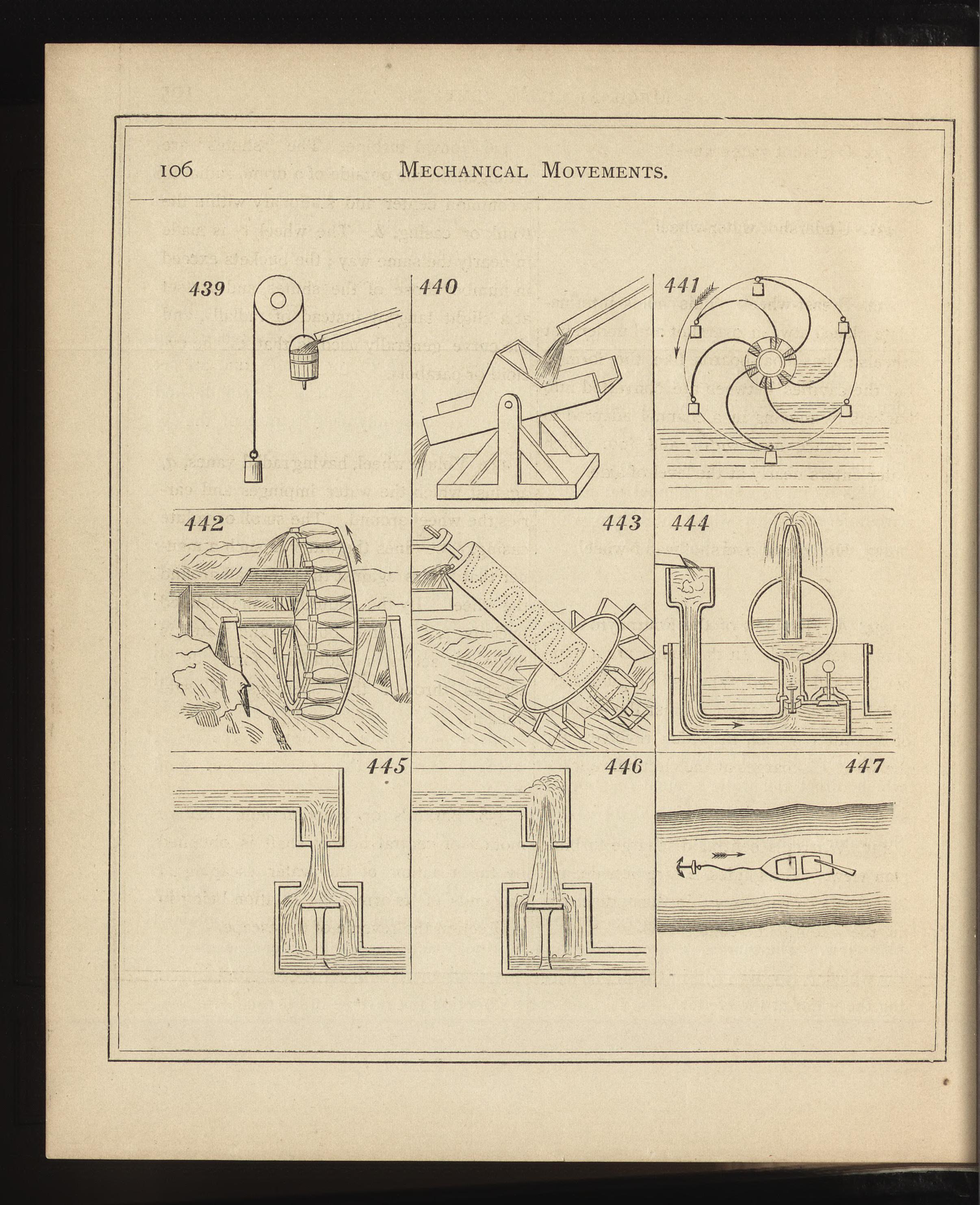
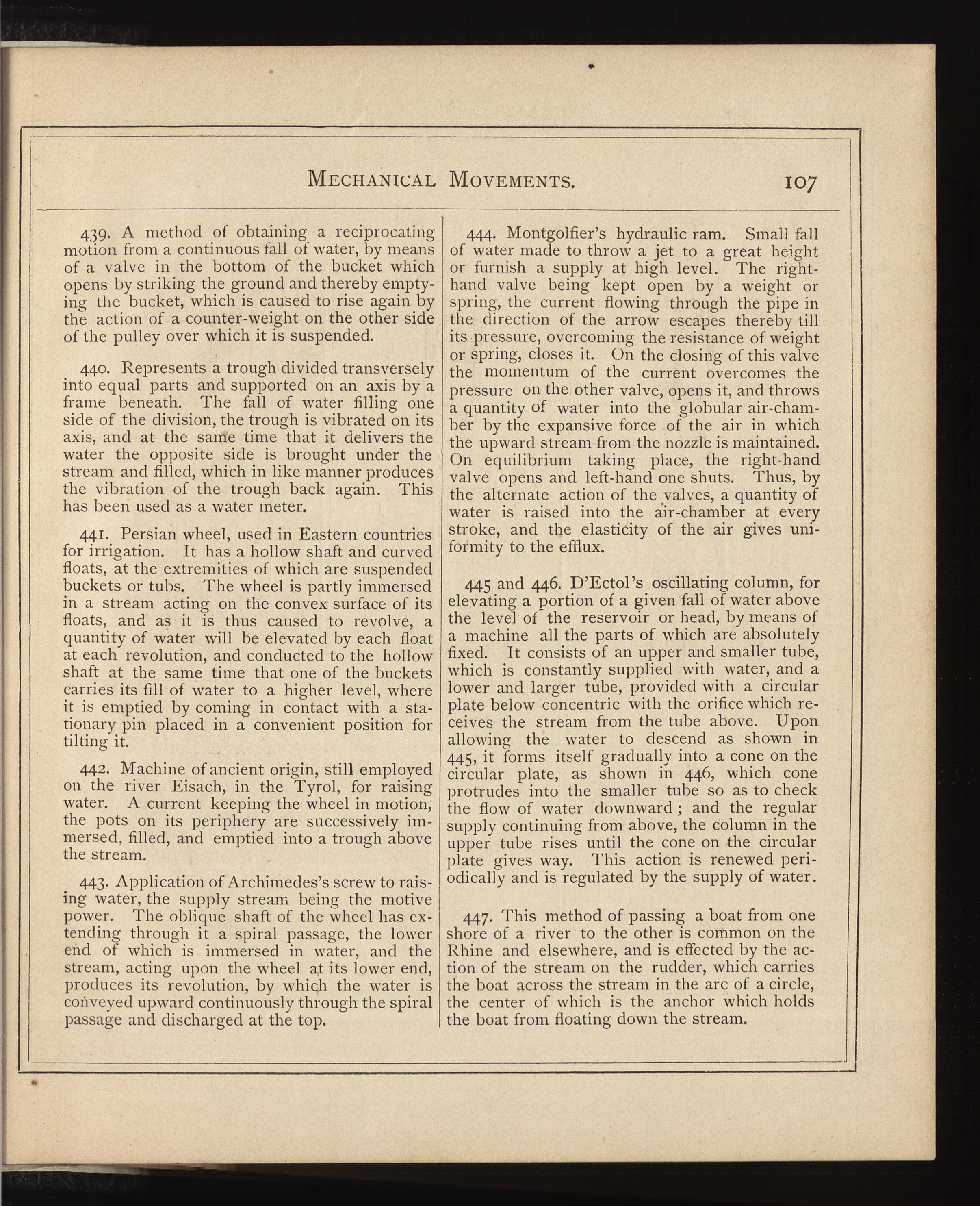
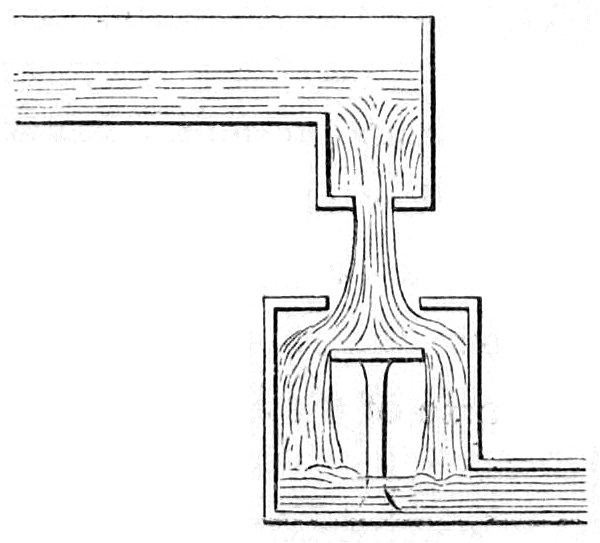
445 and 446. D’Ectol’s oscillating column, for elevating a portion of a given fall of water above the level of the reservoir or head, by means of a machine all the parts of which are absolutely fixed. It consists of an upper and smaller tube, which is constantly supplied with water, and a lower and larger tube, provided with a circular plate below concentric with the orifice which receives the stream from the tube above. Upon allowing the water to descend as shown in 445, it forms itself gradually into a cone on the circular plate, as shown in 446, which cone protrudes into the smaller tube so as to check the flow of water downward; and the regular supply continuing from above, the column in the upper tube rises until the cone on the circular plate gives way. This action is renewed periodically and is regulated by the supply of water.
Only the input is driven; every other part of this model moves by physics (MuJoCo), and its ratios are measured. Run it live, change its parameters, or switch the friction off to see the output stop.
- Modelled as
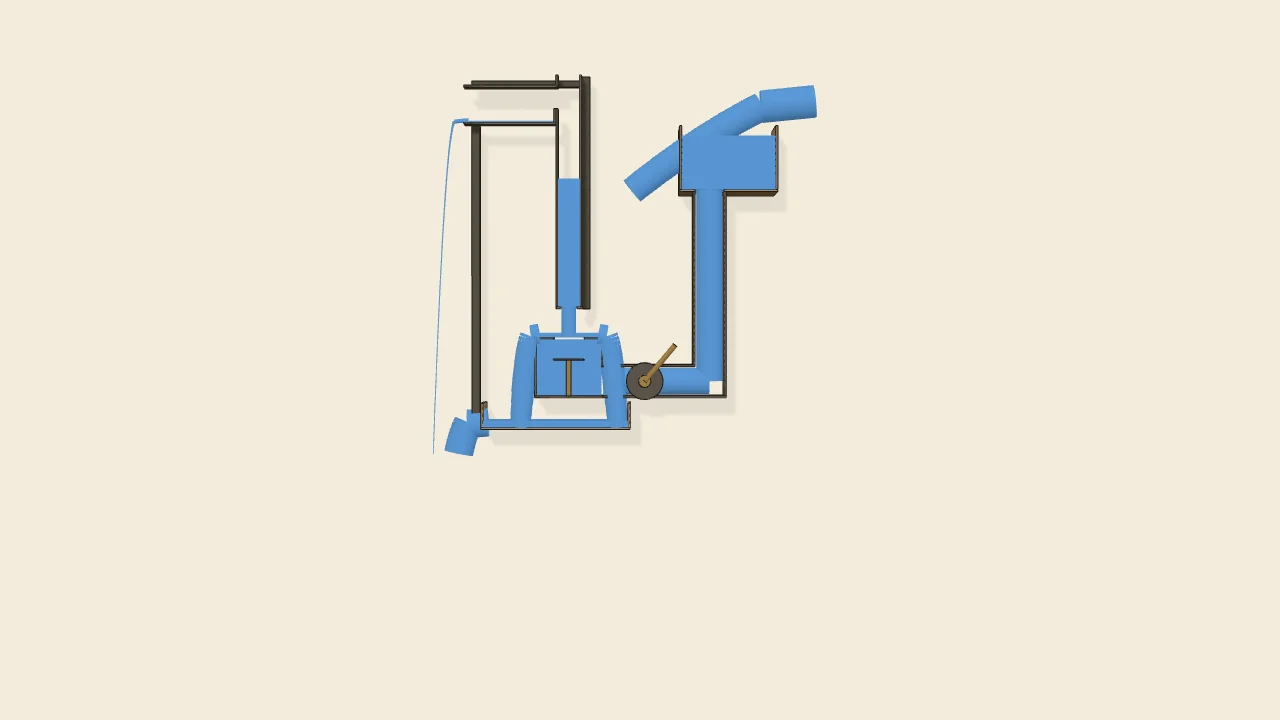
- In section, gravity on. Brown's parts with the water run as the machine's sources give it (Carnot 1813 on Mannoury d'Ectot's colonne oscillante; Lanz and Betancourt; Navier; Caligny): the supply comes up under a constant head through the orifice in the lower tube's lid, past the circular plate under it, across an open interval and into the upper tube. The lower tube, orifice, plate and interval are measured off Brown's figure; the upper tube is narrower than he draws it (radius 16 mm against 24), which doubles the swing. A head cistern (surface 30 cm over the lid) feeds the lower tube through a cock, the only joint, opened by hand and held. Lumped vessels with the jet-borne column: the upper tube's water is one column obeying d(m u)/dt = k mn vn - g m, with k = 0.355 and the orifice's Cd = 0.569 measured on a free-surface CFD run of these proportions (case c9). No threshold, trigger or timer.
- Measured
- With the cock open the jet runs steadily at 2.22 kg/s and the column rises and falls between 16.3 and 29.4 cm every 0.97 s, its crest cut at the lip (CFD of the same proportions, no lip: 11.5 to 35.1 cm every 1.02 s). At each crest about 1.3 g passes a lip 4 cm above the cistern's surface and runs off by the channel; nothing runs back. Nothing stands before the cock opens or after it shuts, and without the jet's momentum nothing climbs (24 tests, water conserved; the lumped column is held to nine CFD series).
- Notes
- shared plate 445–446. The flow is the reverse of Brown's wording, which is steady in every solver tried (branch fluid/445). The head cistern, cock and tray are added; the upper tube is drawn tall enough to hold the column, where Brown shows a short spout. The quantity raised is small (0.06% of each stroke's supply) and is not a validated number: the CFD had no lip, and its crest stands 5.7 cm over this one.
Film (MP4) · Still (WebP) · Spec (YAML) · Model (MJCF)
Brown's pages: the plate · his description (full size) · the whole book