This method of passing a boat from one shore of a river to the…
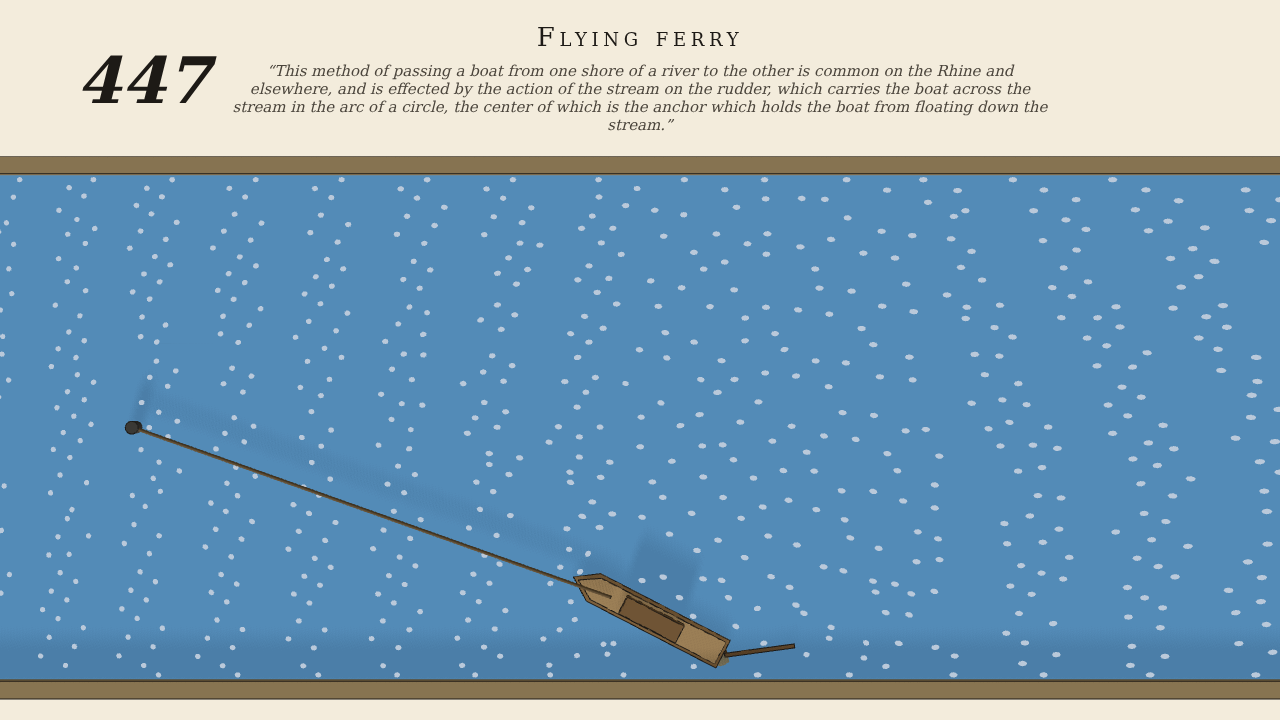
This method of passing a boat from one shore of a river to the other is common on the Rhine and elsewhere, and is effected by the action of the stream on the rudder, which carries the boat across the stream in the arc of a circle, the center of which is the anchor which holds the boat from floating down the stream.
Only the input is driven; every other part of this model moves by physics (MuJoCo), and its ratios are measured. Run it live, change its parameters, or switch the friction off to see the output stop.
- Modelled as
- Seen from above: a river running left to right between two banks (particle water in plan); a boat hangs on a long cable from a buoy anchored upstream, and its rudder, set at an angle, lets the current push it across the river on the arc of the cable. Nothing drives the boat but the current. gen447.py (cfg447).
- Measured
- Seen from above: a river running left to right between two banks (particle water in plan, fed upstream behind a weir off the picture and leaving through a sink off the picture downstream); a boat hangs by a bridle 3 cm aft of its bow on a long cable from a buoy anchored upstream, and its rudder, set 35 degrees, holds the hull at an angle to the current, which pushes it across on the arc of the cable. Nothing drives the boat but the current. gen447.py (cfg447).
- Notes
- The water is drawn as the particles' smoothed surface with pale flecks riding on every ninth particle, so the current shows; it is fed upstream and leaves through a sink off the picture downstream. The boat stops short of the far bank (it rests at the balance angle), and the flecks flicker as particles are recycled.
Film (MP4) · Still (PNG) · Spec (YAML) · Model (MJCF)