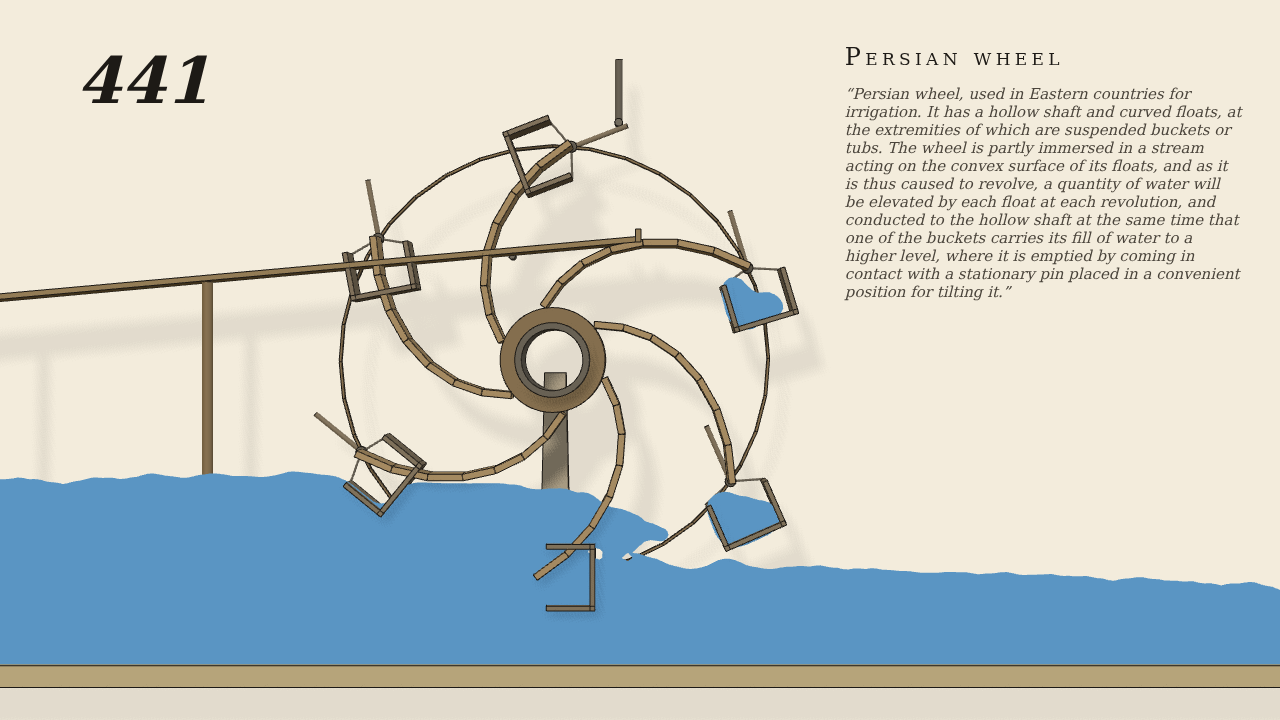
Persian wheel, used in Eastern countries for irrigation
Persian wheel, used in Eastern countries for irrigation. It has a hollow shaft and curved floats, at the extremities of which are suspended buckets or tubs. The wheel is partly immersed in a stream acting on the convex surface of its floats, and as it is thus caused to revolve, a quantity of water will be elevated by each float at each revolution, and conducted to the hollow shaft at the same time that one of the buckets carries its fill of water to a higher level, where it is emptied by coming in contact with a stationary pin placed in a convenient position for tilting it.
Only the input is driven; every other part of this model moves by physics (MuJoCo), and its ratios are measured. Run it live, change its parameters, or switch the friction off to see the output stop.
- Modelled as
- Seen from the side: a wheel with curved floats and hollow spokes turned by the stream running under it (particle water, the stream fed upstream and leaving downstream); buckets hang on pins at the rim, fill as they pass through the stream, and are tipped by a stationary pin near the top, emptying onto a trough that runs left past the wheel and out of the picture. Nothing drives the wheel but the water. gen441.py.
- Measured
- The wheel turns the right way at about 0.2-1.2 rad/s (about 0.53 rad/s mean over 4-8 s; the lighter tier 0.54); each tipped bucket's water runs along the trough and out of the picture to the left.
- Notes
- The water is drawn as the particles' smoothed surface (fluid.draw: surface) each frame; it leaves the simulation only in sinks off the picture (the trough's far end and the stream's outlet). Brown's water conducted through the hollow shaft is shown as the trough; the caption sits at the top right so the wheel fills the plate.
Film (MP4) · Still (PNG) · Spec (YAML) · Model (MJCF)