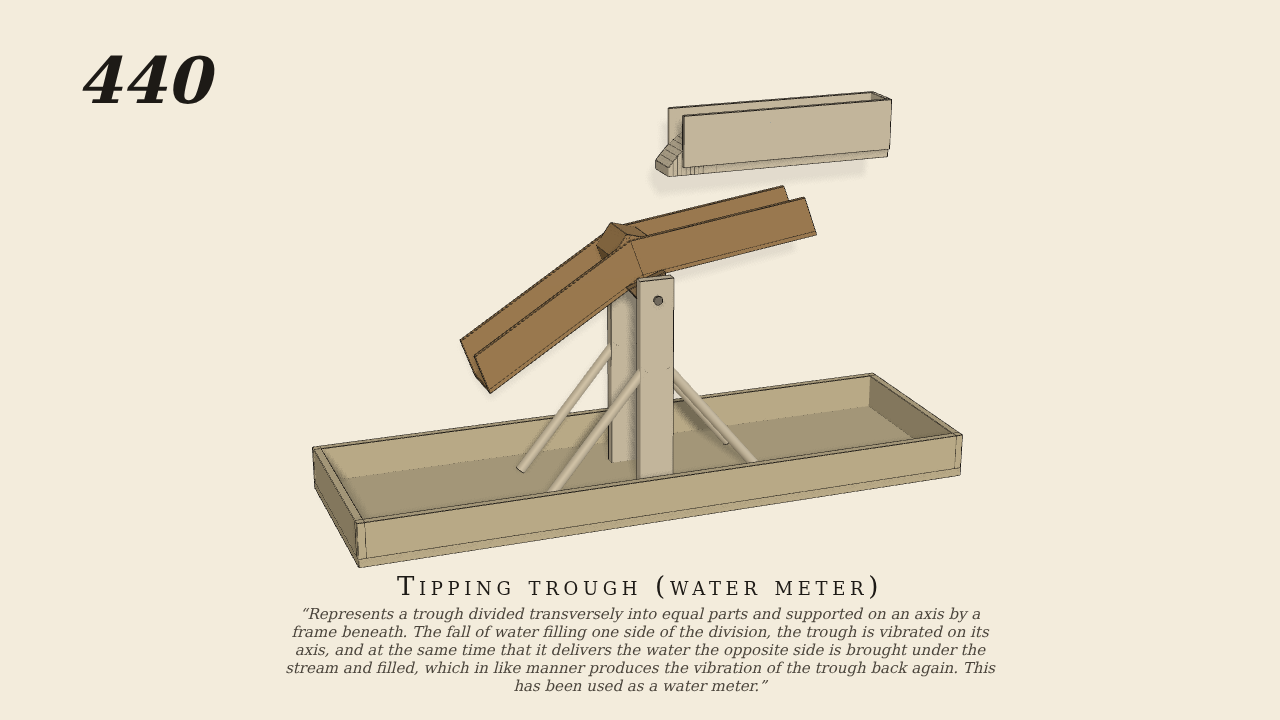
A trough divided transversely into equal parts and supported on an…
Represents a trough divided transversely into equal parts and supported on an axis by a frame beneath. The fall of water filling one side of the division, the trough is vibrated on its axis, and at the same time that it delivers the water the opposite side is brought under the stream and filled, which in like manner produces the vibration of the trough back again. This has been used as a water meter.
Only the input is driven; every other part of this model moves by physics (MuJoCo), and its ratios are measured. Run it live, change its parameters, or switch the friction off to see the output stop.
- Modelled as
- Seen from in front, a little to the left and above, as Brown, gravity on. The trough is 26 cm long and 3.2 cm wide inside and weighs 20 g. It is two arms falling 12 degrees each way from a gabled block across the middle (Brown's raised middle), with ears down to an axis 1.5 cm under the ridge, carried on two braced standards in a shallow tray. It tips 20 degrees each way between stops. Tipped one way, the raised arm slopes back towards the middle and holds water, while the lowered arm slopes 32 degrees down to its open end and empties. The water is 100 parcels, each a smooth ball 1 cm across at 1 g/cm³. They start at rest in a nearly level spout from the right and reach its rounded edge above the middle at a steady rate from 0.2 s to 12 s. They fall on the ridge and run off into whichever arm is raised. Each parcel moves freely in space (three slides) and touches the spout, trough and tray but not other parcels. The water is the only input. Nothing is driven.
- Measured
- The first water reaches the trough at about 3 s. Once about 10 to 15 parcels lie in the raised arm, the trough tips over to the other stop, the arm empties into the tray, and the other arm comes under the stream. It tips at about 3.6, 6.3, 8.1, 9.5, 11.9 and 13.3 s, each time 40 degrees. Contact penetration stays within 0.6 mm.
- Notes
- The water is modelled as separate parcels that do not touch one another, so it all lies in the lowest corner of the raised arm. The axis is set close under the floor so that this water is outboard of the axis. The division is a gabled block rather than a thin board, so the stream is shed into the raised arm. The stops are the hinge's range limits. The spout is nearly level with a rounded edge rather than Brown's steep one.
Film (MP4) · Still (PNG) · Spec (YAML) · Model (MJCF)