A method of obtaining a reciprocating motion from a continuous…
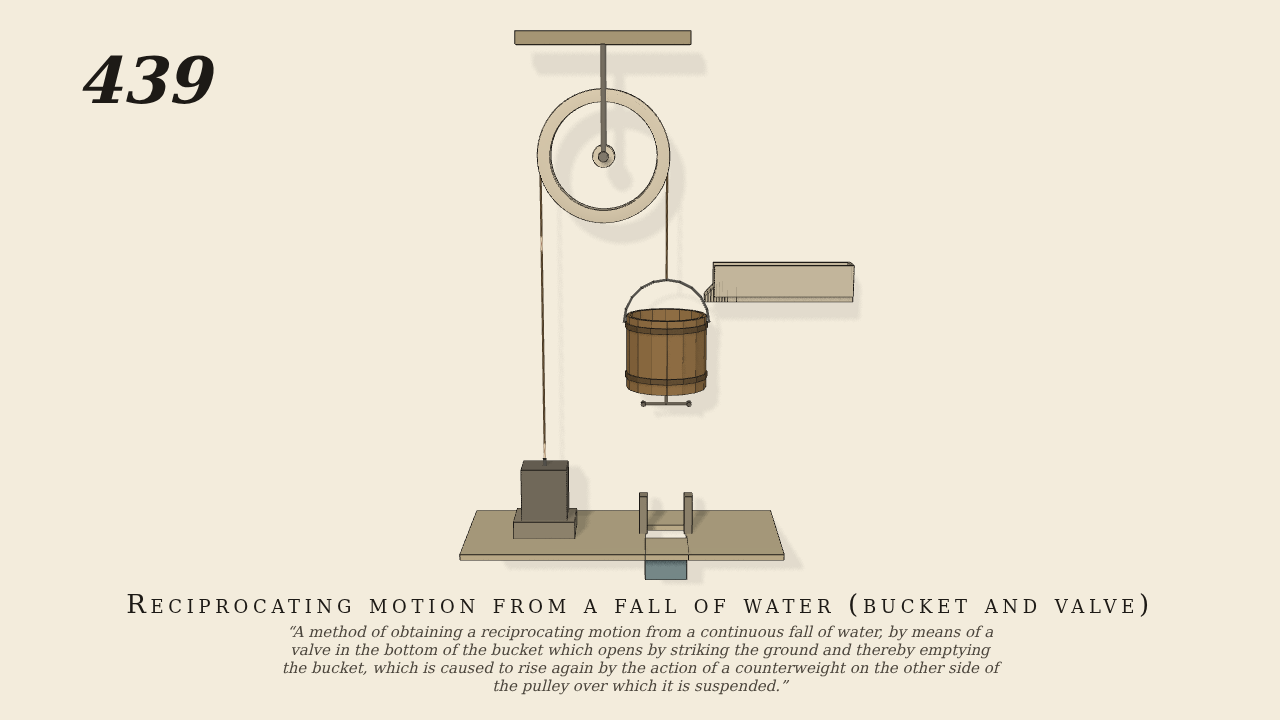
A method of obtaining a reciprocating motion from a continuous fall of water, by means of a valve in the bottom of the bucket which opens by striking the ground and thereby emptying the bucket, which is caused to rise again by the action of a counterweight on the other side of the pulley over which it is suspended.
Only the input is driven; every other part of this model moves by physics (MuJoCo), and its ratios are measured. Run it live, change its parameters, or switch the friction off to see the output stop.
- Modelled as
- Brown's view from in front, gravity on. A cord (a chain of 44 short links) runs over a free pulley 13.75 cm across from a 40 g counterweight on the left to the bail of a 25 g wooden bucket on the right. The bucket (8.4 cm across inside, 16 staves) has a bottom falling to a round hole 3.6 cm across, closed from inside by a 4 g valve: a low cone resting on the hole, on a stem that stands out 2 cm below the bucket and ends in a cross-piece. Two stones stand in the ground under the bucket, beside a pit. When the bucket is up the counterweight rests on a block. The water is 70 parcels, each a smooth ball 1.2 cm across at 1 g/cm³, which start at rest in a nearly level spout and reach its rounded edge over the bucket at a steady rate from 0.2 s to 12 s. Each parcel moves freely in space (three slides) and touches the spout, bucket, valve and ground but not other parcels. The water is the only input. Nothing is driven.
- Measured
- The first water reaches the bucket at about 3 s. Once about 14 to 19 parcels have collected, the bucket outweighs the counterweight and goes down 12 cm. The cross-piece strikes the stones and lifts the valve up to 1.6 cm, the water runs out into the pit, and the counterweight draws the empty bucket up again while the valve falls back on its seat. This happens at about 5.5 s, 8.7 s and 12.3 s, and the pulley turns to and fro with the cord. Contact penetration stays within 0.5 mm.
- Notes
- The water is modelled as separate parcels that do not touch one another. The valve is lifted by a cross-piece striking two stones beside a pit rather than by the bucket striking flat ground, so that the water has somewhere to go. The counterweight rests on a block when the bucket is up, which limits how far the bucket rises. The spout is nearly level with a rounded edge rather than Brown's steep trough, so the water arrives at a steady rate.
Film (MP4) · Still (PNG) · Spec (YAML) · Model (MJCF)