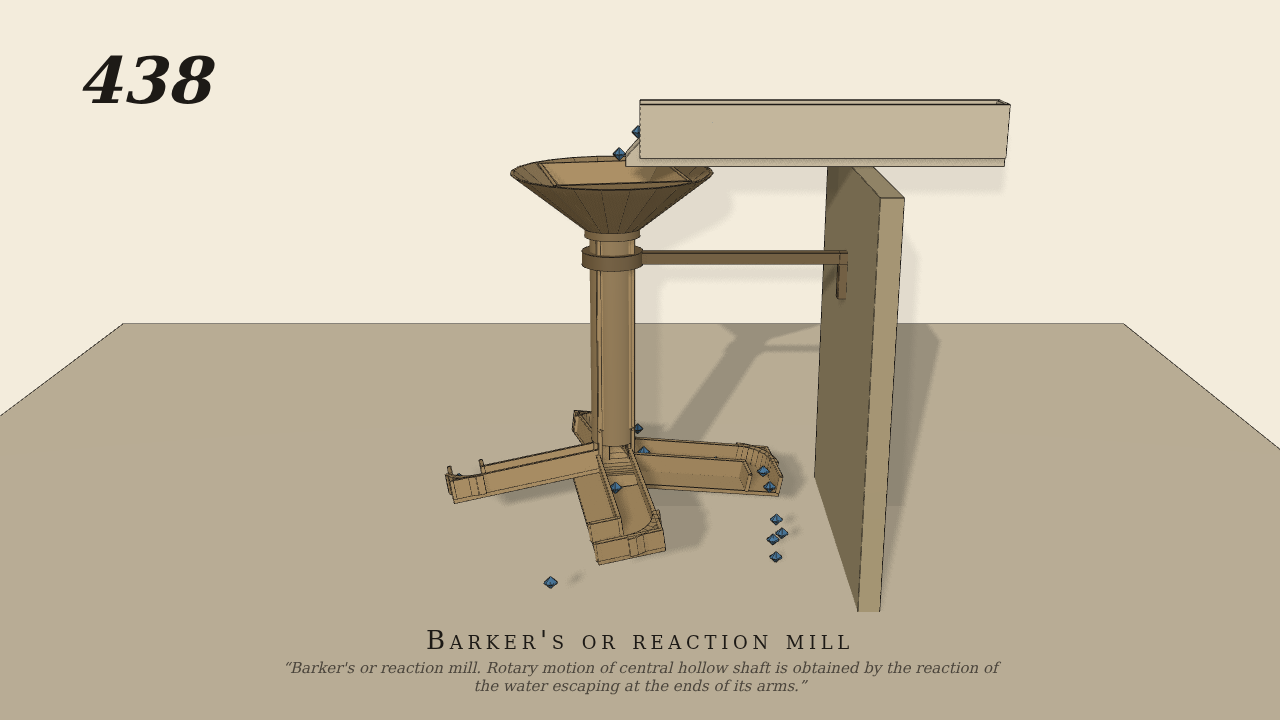
Barker’s or reaction mill
Barker’s or reaction mill. Rotary motion of central hollow shaft is obtained by the reaction of the water escaping at the ends of its arms, the rotation being in a direction the reverse of the escape.
Only the input is driven; every other part of this model moves by physics (MuJoCo), and its ratios are measured. Run it live, change its parameters, or switch the friction off to see the output stop.
- Modelled as
- Brown's view from in front and a little above, gravity on. The water runs along a straight, nearly level feed and over a rounded edge into the funnel on top of the hollow upright shaft, which turns in a collar on a bracket from the wall and stands on a step. It falls down the shaft's 2.2 cm square bore and is parted at its foot by four curved faces into the four arms, which reach 11 cm out, are open above so the water can be seen in them, and droop a little (12 degrees) towards their ends. Each arm turns at its end through a quarter round into a short nozzle with rounded lips pointing back, clockwise seen from above. The water is 180 parcels, each a smooth ball 0.9 cm across at 1 g/cm³. They start at rest in the feed, spread so that they reach the edge at a steady rate from 0.2 s to 9.5 s. Each parcel moves freely in space (three slides) and touches the feed, funnel, bore and arms but not other parcels. The water is the only input. Nothing is driven (there is a zero-torque driver), and the shaft works against a load (0.0001 N m s).
- Measured
- The first water reaches the arms at about 2.2 s. From rest the shaft turns anticlockwise seen from above, the reverse of the escape, as Brown says, at about 1.7 to 1.9 rad/s once the water runs, never running back. The water runs out along the arms, round the bends and out of the nozzles backwards. Contact penetration stays within 2.5 mm.
- Notes
- The water is modelled as separate parcels that do not touch one another, so there is no pressure head in the shaft; instead the arms droop a little so the water runs out along them and leaves the nozzles moving backwards. The arms are open above (Brown's are closed tubes) so the water can be seen, and the bore is square inside a round shaft. The parcels are released from rest in the feed rather than supplied continuously.
Film (MP4) · Still (PNG) · Spec (YAML) · Model (MJCF)