Warren’s central discharge turbine, plan view
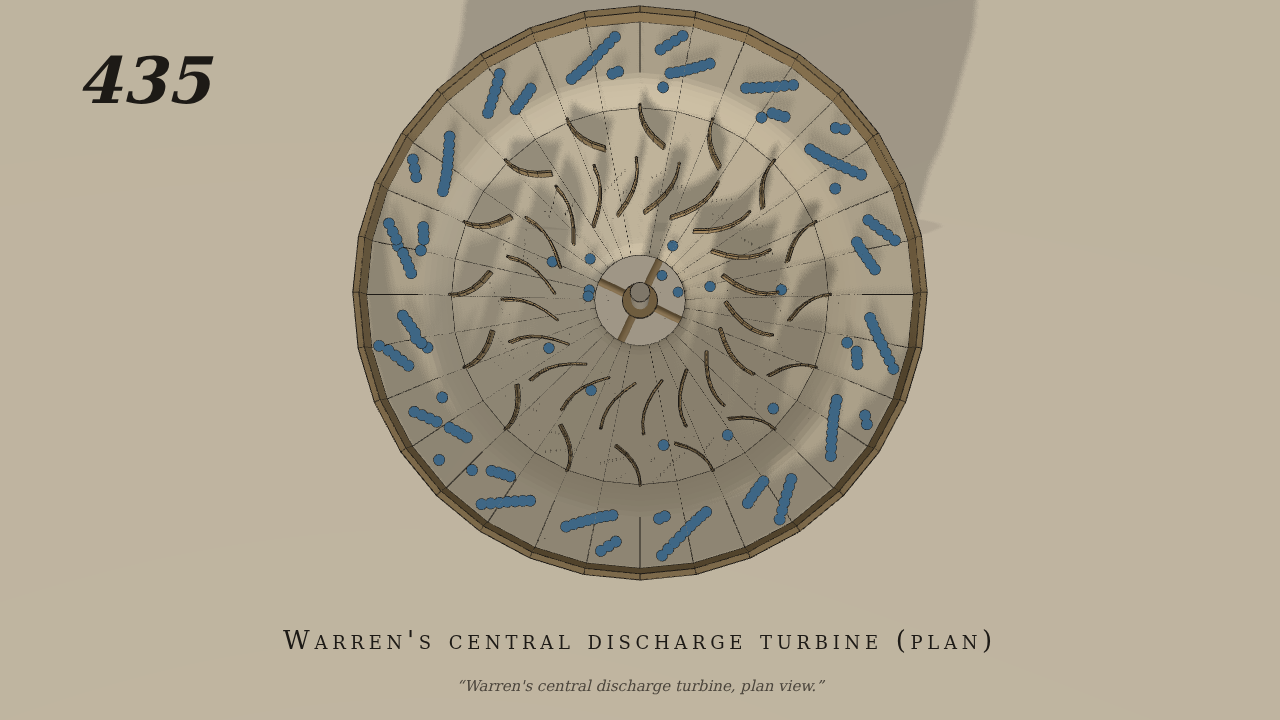
Warren’s central discharge turbine, plan view. The guides, a, are outside, and the wheel, b, revolves within them, discharging the water at the center.
Only the input is driven; every other part of this model moves by physics (MuJoCo), and its ratios are measured. Run it live, change its parameters, or switch the friction off to see the output stop.
- Modelled as
- Brown's plan view, from above, gravity on. The water comes in from all round over a fixed floor: a nearly level outer ring, then a rounded edge falling 1.9 cm inwards, which gives it its speed (about 0.6 m/s). Inside that the floor falls gently (20 degrees) towards an opening in the middle, standing for the head that drives the water inward. 16 fixed curved guides (a), from 16 to 13 cm out, stand on the floor and turn the water 65 degrees towards the way the wheel goes. It then passes inwards through the 20 curved buckets of the wheel (b), from 11.8 to 7.5 cm out, which turn it back the other way, and it drops through the opening in the middle. The buckets hang just clear of the floor from a crown below it, joined by four arms to the upright shaft; the arms and hub show through the opening. A casing rings the outside. The vanes have rounded leading edges and the opening a rounded lip. The water is 220 parcels, each a smooth ball 0.9 cm across at 1 g/cm³. They start at rest on the outer ring, each down the middle of a channel between two guides, spread so that they reach the edge at a steady rate from 0.2 s to 9.5 s. Each parcel moves freely in three directions on three slides. It touches the floor, casing, guides and buckets but not other parcels. The water is the only input. Nothing is driven (there is a zero-torque driver), and the shaft works against a load (0.0001 N m s).
- Measured
- The first water reaches the buckets at about 1.5 s. From rest the wheel turns clockwise seen from above (Brown's arrows) and settles at about 2.7 rad/s (26 rev/min) while the water runs, never running back. The water leaves the buckets on the inside and drops through the opening in the middle. Contact penetration stays within 1.9 mm.
- Notes
- The water is modelled as separate parcels that do not touch one another. Its head is a fall over a rounded edge and a floor sloping down towards the middle rather than the pressure of a full casing. The parcels are released from rest on the outer ring rather than supplied continuously, and they fall onto the tail-water below the opening.
Film (MP4) · Still (PNG) · Spec (YAML) · Model (MJCF)