Jonval turbine
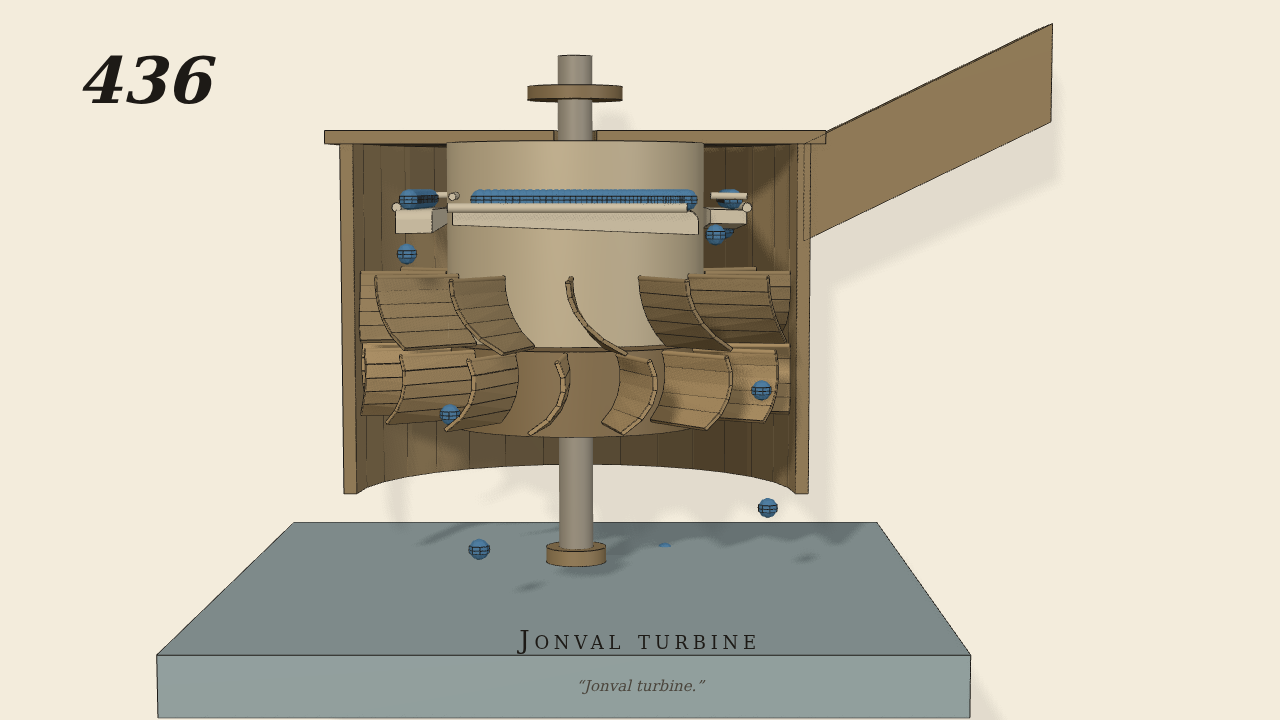
Jonval turbine. The “shutes” are arranged on the outside of a drum, radial to a common center and stationary within the trunk or casing, b. The wheel, c, is made in nearly the same way; the buckets exceed in number those of the shutes, and are set at a slight tangent instead of radially, and the curve generally used is that of the cycloid or parabola.
Only the input is driven; every other part of this model moves by physics (MuJoCo), and its ratios are measured. Run it live, change its parameters, or switch the friction off to see the output stop.
- Modelled as
- Brown's sectional elevation, from the front, gravity on; the near half of the trunk (b) is cut away to show the shutes and wheel. The water passes downwards through the ring between a drum (6 cm) and the trunk (10 cm). On the drum stand 12 fixed curved shutes (a), radial to the axis, 3 cm deep; they take the falling water and turn it 60 degrees from upright towards the way the wheel goes. Just below them (0.35 cm gap) the wheel (c) carries 16 curved buckets, more than the shutes, also 3 cm deep, which turn the water back the other way; it then falls out below. The wheel's drum is fixed on the upright shaft, which runs through the shute drum and the trunk's lid to a step below. Above the shutes, the water from the supply pipe is spread round the trunk by four straight troughs. Each falls gently along its length and slightly outwards towards a rounded rail, and ends in a rounded edge from which the water drops 3 cm onto the shutes (about 0.77 m/s). The shutes and buckets have rounded top edges. The water is 220 parcels, each a smooth ball 0.9 cm across at 1 g/cm³. They start at rest in the troughs, spread so that they leave them at a steady rate from 0.2 s to 9.5 s. Each parcel moves freely round the axis, in and out, and up and down (a hinge on the axis and two slides, whose stops stand for the drum and the trunk walls). It touches the troughs, shutes and buckets but not other parcels. The water is the only input. Nothing is driven (there is a zero-torque driver), and the shaft works against a load (0.0002 N m s).
- Measured
- The first water drops onto the shutes at about 2 s. From rest the wheel turns anticlockwise seen from above (the near buckets move to the right) and settles at about 2.7 rad/s (26 rev/min) while the water runs, never running back. The water leaves the buckets underneath and falls out of the trunk. Contact penetration stays within 0.7 mm.
- Notes
- The water is modelled as separate parcels that do not touch one another. Its head is a short fall from feed troughs rather than the pressure of a trunk full of water, and the parcels are released from rest in the troughs rather than supplied continuously. The drum and trunk walls act as stops on each parcel's in-and-out slide rather than as solid surfaces, so that the near half of the trunk can be cut away as in Brown's figure. Brown's buckets are set at a slight tangent; here they are radial, like the shutes.
Film (MP4) · Still (PNG) · Spec (YAML) · Model (MJCF)