Breast-wheel
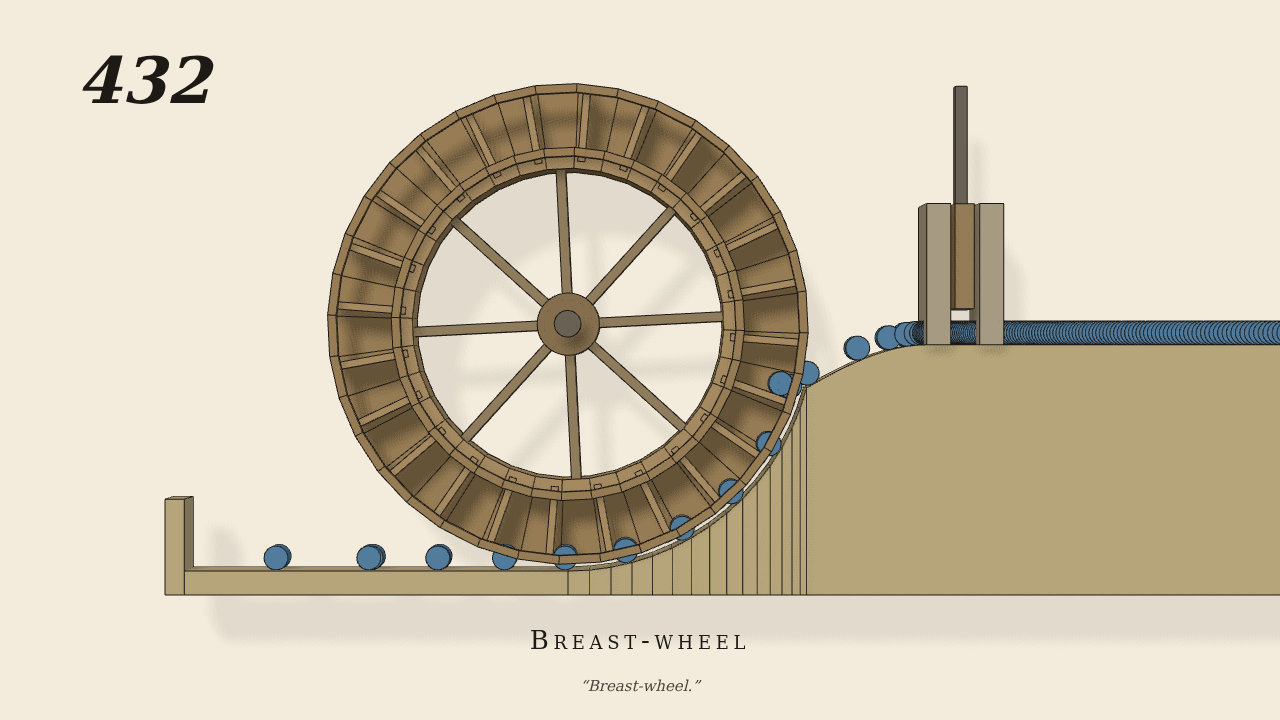
Breast-wheel. This holds intermediate place between overshot and undershot wheels; has float-boards like the former, but the cavities between are converted into buckets by moving in a channel adapted to circumference and width, and into which water enters nearly at the level of axle.
Only the input is driven; every other part of this model moves by physics (MuJoCo), and its ratios are measured. Run it live, change its parameters, or switch the friction off to see the output stop.
- Modelled as
- Brown's side view, gravity on. A wooden wheel 20 cm across has 24 float-boards between the sole (7 cm) and the shrouds. The near shroud is drawn as two thin rings, so the water shows between them. The wheel turns in a breast concentric with it, 0.3 cm clear, which runs from the sill, 15 degrees below the level of the axle, down to the bottom. The breast closes the cavities between the floats into buckets. A sluice gate stands in the head-race to the right. The water is 180 parcels, each a short smooth cylinder 1 cm across at 1 g/cm³. They start at rest along a smooth, nearly level head-race, spread along it so that they pass under the gate at a steady rate from 0.2 s to 9.5 s. They then drop 1.8 cm down a short smooth fall and over the sill into the buckets. Each parcel moves freely in the plane of the wheel on two slides. It touches the race and the wheel but not other parcels, and leaves the buckets into the tail-race at the bottom. The water's weight is the only input. Nothing is driven (there is a zero-torque driver), and the shaft works against a load (0.004 N m s).
- Measured
- The first water enters the buckets at about 0.7 s. From rest the wheel turns clockwise as drawn (Brown's arrow) and runs at about 1.6 rad/s (15 rev/min) while the water runs, never running back. The buckets carry their water down the breast and empty it into the tail-race at the bottom. About half of the water's fall reaches the load. Contact penetration stays within 2.3 mm.
- Notes
- The water is modelled as separate parcels that do not touch one another (they can overlap in a bucket). They are released from rest along a long, nearly level head-race rather than supplied continuously. A short fall before the sill gives them the speed to enter the buckets, and the floats start with the sill opposite a bucket: a float tip standing at the sill at rest holds the first water out. The gate is fixed open, the ground is drawn without hatching, and the parcels keep moving along the tail-race until its end wall.
Film (MP4) · Still (PNG) · Spec (YAML) · Model (MJCF)