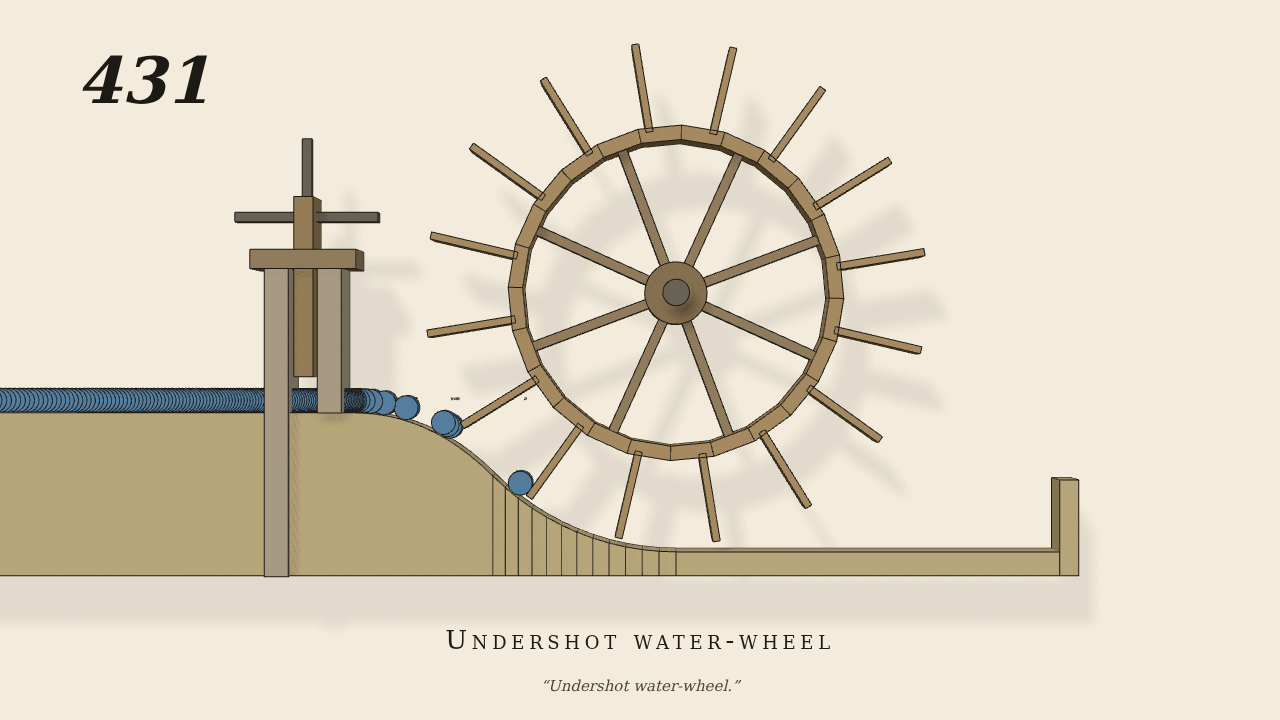
Undershot water-wheel
Undershot water-wheel.
Only the input is driven; every other part of this model moves by physics (MuJoCo), and its ratios are measured. Run it live, change its parameters, or switch the friction off to see the output stop.
- Modelled as
- Brown's side view, gravity on. A wooden wheel 21 cm across on its axle, with a rim, eight spokes and 16 flat radial floats, stands over a curved race concentric with it. A sluice gate with its stem and handles stands in the head-race to the left. The water is 180 parcels, each a short smooth cylinder 1 cm across at 1 g/cm³. They start at rest along a smooth, nearly level head-race that ends in a convex fall into the curved race, and are spaced so they pass under the gate and down the fall at a steady rate from 0.2 s to 9.5 s. Each parcel moves freely in the plane of the wheel on two slides. It touches the race and the floats but not other parcels, strikes the floats at the bottom of the wheel, and runs on into the tail-race. The water is the only input. Nothing is driven (there is a zero-torque driver), and the shaft works against a load.
- Measured
- The first water reaches the floats at about 1 s. From rest the wheel turns anticlockwise as drawn (Brown's arrow; the bottom moves with the stream) and runs at about 2.6 rad/s (25 rev/min) while the water runs, never running back after the first 1.5 s. The water's arrival gives a brief 0.1 rad jolt backwards at 1.06 s, which the check's settle time excludes. The floats carry each parcel along the race and release it into the tail-race. About a fifth of the water's fall energy is delivered to the load. Contact penetration stays within 1.7 mm.
- Notes
- The water is modelled as separate parcels that do not touch one another. They are released from rest along a long, nearly level head-race rather than supplied continuously, and their level stands higher than in Brown's figure, so that they have a fall to gain speed before the wheel. The race is curved under the wheel to keep the floats close to it. The gate is fixed open, at a height that just clears the parcels. The masonry is drawn without hatching, and the parcels keep moving along the tail-race until its end wall. The startup jolt is a transient while the water first arrives.
Film (MP4) · Still (PNG) · Spec (YAML) · Model (MJCF)