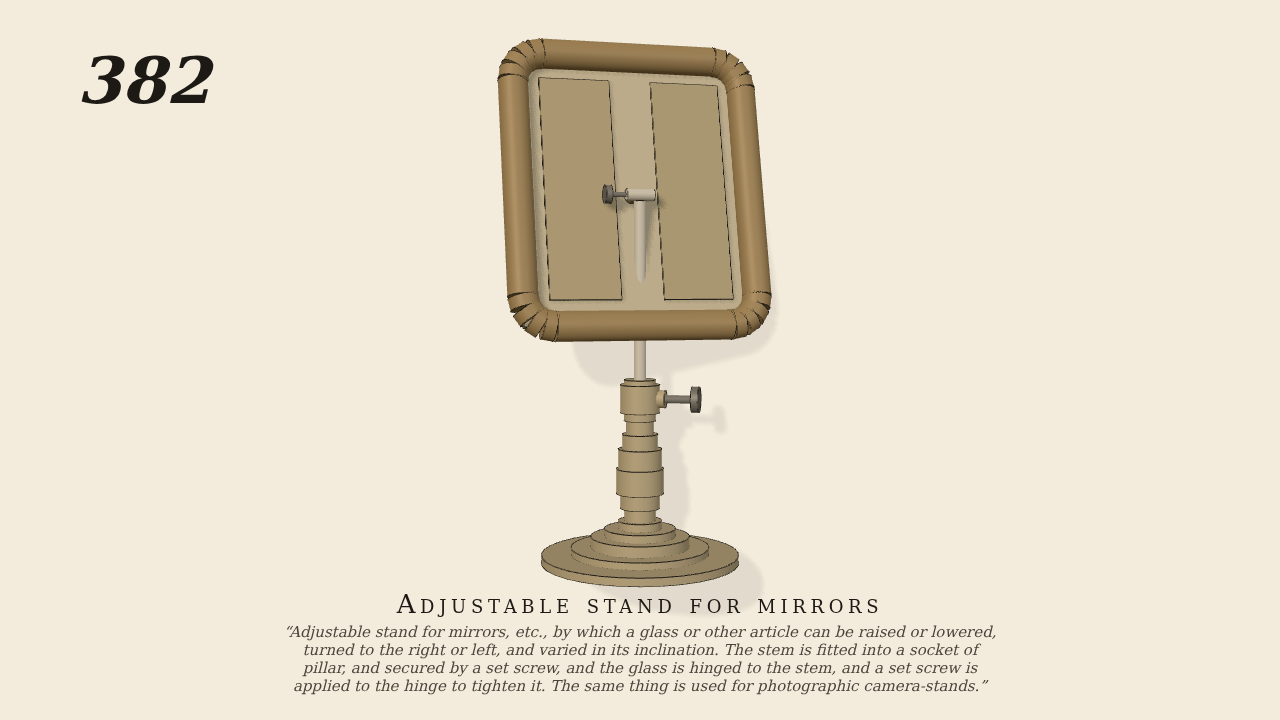
Adjustable stand for mirrors, etc., by which a glass or other…
Adjustable stand for mirrors, etc., by which a glass or other article can be raised or lowered, turned to the right or left, and varied in its inclination. The stem is fitted into a socket of pillar, and secured by a set screw, and the glass is hinged to the stem, and a set screw is applied to the hinge to tighten it. The same thing is used for photographic camera-stands.
Only the input is driven; every other part of this model moves by physics (MuJoCo), and its ratios are measured. Run it live, change its parameters, or switch the friction off to see the output stop.
- Modelled as
- A baluster pillar on a round foot with a socket in its top. The stem stands in the socket (a slide joint, the bore), the glass in its frame hinged on the stem's top; the hinge's set screw is its friction (3 N m), and the glass leans on the hinge's back stop. The hand lifts the glass by a soft spring (100 N/m, its free end raised 23 cm by 2 s), and the set screw in the side of the socket is run in by a steady 80 N thrust of the hand (the only driven joint; its thread as its guide, its friction as a damper, so it creeps in at 0.35 cm/s). At 3.8 s the hand lets go.
- Measured
- The stem rises 4.3 cm; the screw's point meets it at 2.6 s and bites; after the hand lets go the glass stays up on the screw alone (4.23 to 4.25 cm, creeping under 0.001 cm/s).
- Notes
- Turning to right or left and the inclination are not exercised: the glass stands square to the view, and its hinge is held by friction, not by a modelled screw. The pillar is a stack of turned rings.
Film (MP4) · Still (PNG) · Spec (YAML) · Model (MJCF)