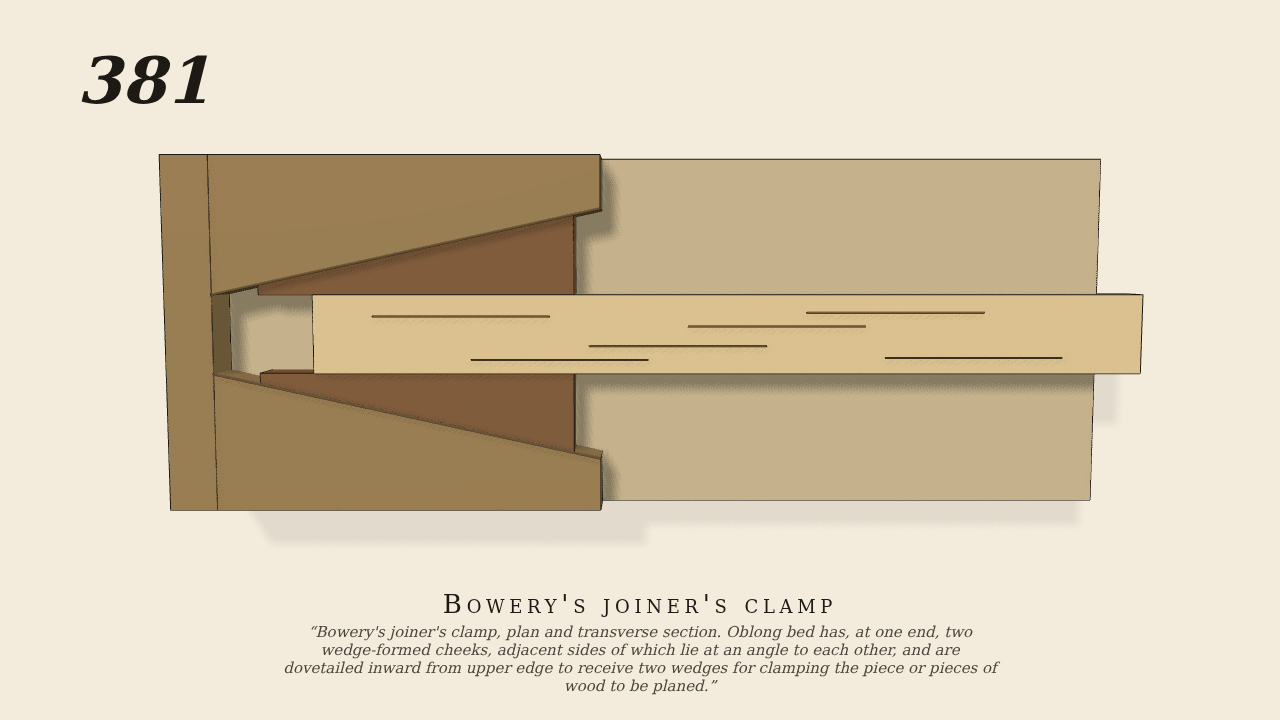
Bowery’s joiner’s clamp, plan and transverse section
Bowery’s joiner’s clamp, plan and transverse section. Oblong bed has, at one end, two wedge-formed cheeks, adjacent sides of which lie at an angle to each other, and are dovetailed inward from upper edge to receive two wedges for clamping the piece or pieces of wood to be planed.
Only the input is driven; every other part of this model moves by physics (MuJoCo), and its ratios are measured. Run it live, change its parameters, or switch the friction off to see the output stop.
- Modelled as
- Brown's plan: an oblong bed with two cheeks at one end whose faces close toward the end (12.4 degrees each), each dovetailed to take a wedge that slides along it (a slide joint along the face), its inner face parallel to the board. The board is thrust endwise toward the cheeks, as the plane pushes it: the only driven motion, a steady 30 N (its drag on the bed as a damper, so it goes in at 0.8 cm/s while free). At 1.6 s the joiner sets the wedges with a light push (a 60 N/m spring each, stepped in by hand).
- Measured
- The board goes in freely 1.57 cm; the wedges slide 1.40 cm along their dovetails to meet it and are drawn in by its friction until they jam between cheek and board; the board then stands against the full 30 N thrust (creeping 0.007 cm/s from 3.5 s, the contact's softness).
- Notes
- Gravity off: the bed lies flat and the plan is drawn in the picture plane. Brown's transverse section is not shown. Contact is rigid wood, so the wedges are drawn in only a little before they jam.
Film (MP4) · Still (PNG) · Spec (YAML) · Model (MJCF)