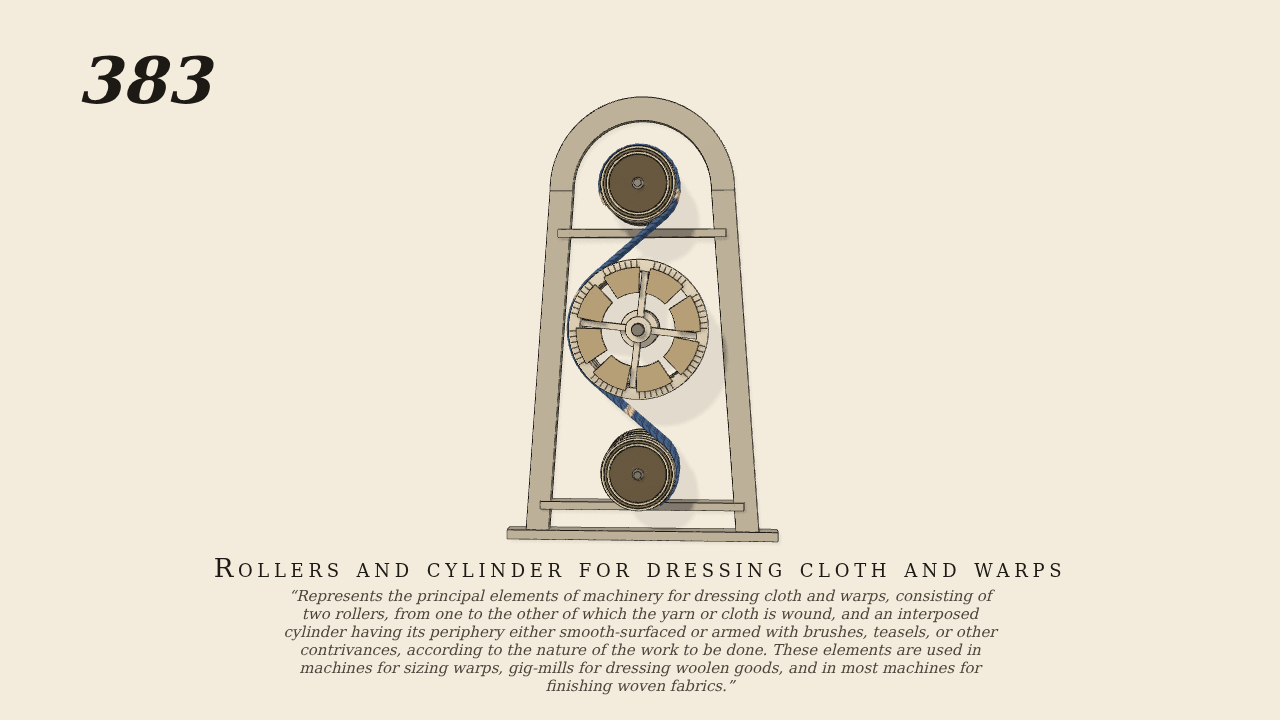
The principal elements of machinery for dressing cloth and warps,…
Represents the principal elements of machinery for dressing cloth and warps, consisting of two rollers, from one to the other of which the yarn or cloth is wound, and an interposed cylinder having its periphery either smooth-surfaced or armed with brushes, teasels, or other contrivances, according to the nature of the work to be done. These elements are used in machines for sizing warps, gig-mills for dressing woolen goods, and in most machines for finishing woven fabrics.
Only the input is driven; every other part of this model moves by physics (MuJoCo), and its ratios are measured. Run it live, change its parameters, or switch the friction off to see the output stop.
- Modelled as
- Gravity on. Brown's front view: two rollers one above the other in a tapered arched frame, a larger cylinder between them, and the warp running in an S from the upper roller round the left of the cylinder to the lower roller. Here the warp is three yarns, each a cord of elastic links. Each yarn is tied to the upper roller with 330 degrees wound on, and runs off its lower right. It crosses to the cylinder, wraps about 100 degrees round its left side, and crosses to the lower roller's upper right, where it is tied with 40 degrees on. The lower (take-up) roller is the only driven joint, turning clockwise at 4.5 rpm and winding the warp on. The upper (supply) roller pays it out against a 0.25 N m friction brake, which sets the yarn's tension. The cylinder is free on its axle with a little bearing friction, and only the yarn's friction on its smooth face turns it, the other way. Its cards and teasels are cosmetic, drawn on its front face inside the yarn's path.
- Measured
- The cylinder turns at -0.5475 of the take-up roller's speed (the radii's ratio, -(4.5+0.3)/(8.5+0.3) = -0.5455). The supply roller follows the take-up roller at 1.00, as the length wound on equals the length paid out. The deepest contact is 0.06 mm.
- Notes
- Brown gives no sizes. The cloth is shown as three warp yarns, because the cords are round chains of links. The cloth's growing and shrinking radius as it winds is not modelled: the warp wraps under one turn on each roller. Brown's teasels stand out from the cylinder's face; here they stay inside the yarn's radius so they do not hide it.
Film (MP4) · Still (PNG) · Spec (YAML) · Model (MJCF)