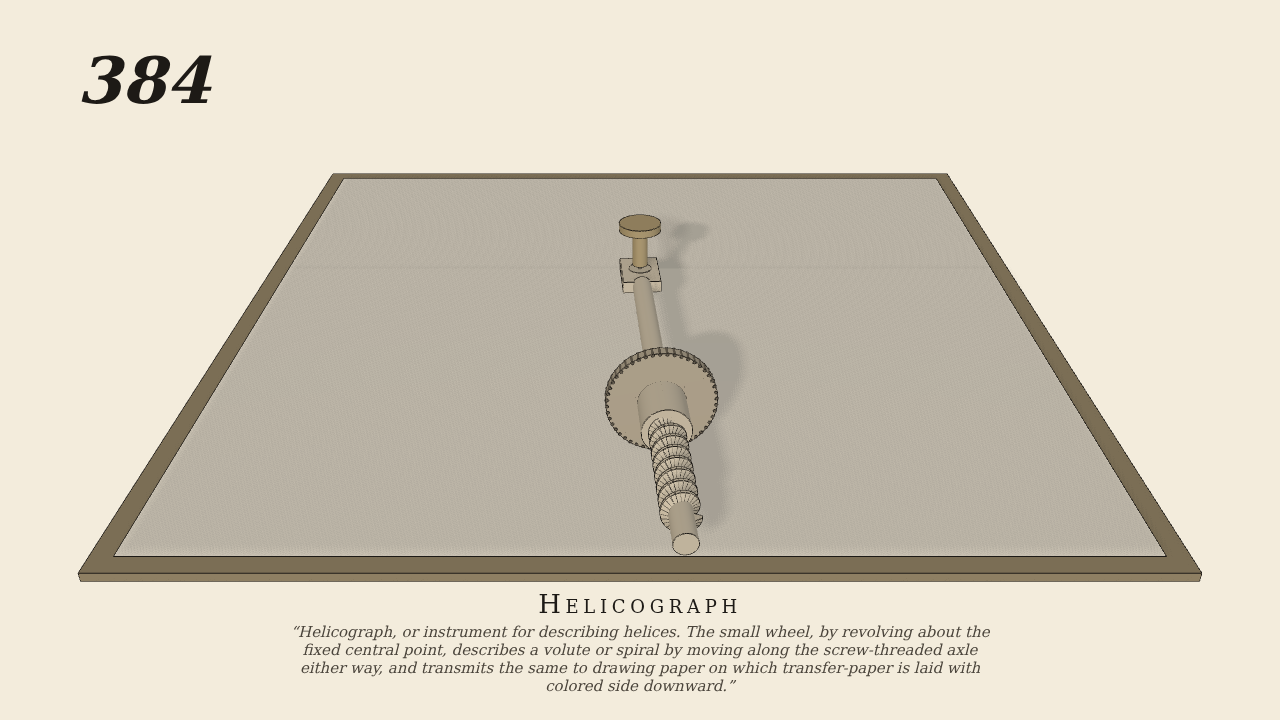
Helicograph, or instrument for describing helices
Helicograph, or instrument for describing helices. The small wheel, by revolving about the fixed central point, describes a volute or spiral by moving along the screw-threaded axle either way, and transmits the same to drawing paper on which transfer-paper is laid with colored side downward.
Only the input is driven; every other part of this model moves by physics (MuJoCo), and its ratios are measured. Run it live, change its parameters, or switch the friction off to see the output stop.
- Modelled as
- Gravity on. A needle stuck in the drawing board is the fixed central point. The screw-threaded axle (right hand, pitch 0.8, real flank contact as in No. 380) is looped over the needle by an eye. It is swept round clockwise (seen from above) at 6 turns a minute by hand, the only driven joint. The axle is free to rock up and down on the needle, so the small wheel (2.5 cm radius, milled edge), threaded on it as a nut, rests on the paper under its own weight and the axle's. As the axle sweeps, friction alone makes the wheel roll on the paper. Rolling, it turns on the thread and screws itself out along the axle by 0.8 cm a turn. The wheel turns r/2.5 times per turn of the axle, so r grows in proportion to itself: the volute is a logarithmic spiral.
- Measured
- On the thread the wheel goes out 0.1264 cm per radian of the wheel (0.1273 geometric). Rolling, it turns about 5.4 times the axle's angle (the mean track radius 14.3 cm / 2.5 cm gives 5.7; the shortfall is a little slip on the paper). Over 12 s the axle sweeps a little over a turn, and the wheel goes out from 12.2 to about 16.6 cm from the point.
- Notes
- Brown gives no sizes. The camera is raised above Brown's side view so that the sweep round the point can be seen. The spiral the wheel marks is not drawn on the paper, since the model has no trace. The rim collides as a capsule: where it bears, it is a cylinder of the wheel's radius.
Film (MP4) · Still (PNG) · Spec (YAML) · Model (MJCF)