Contrivance employed in Russia for shutting doors
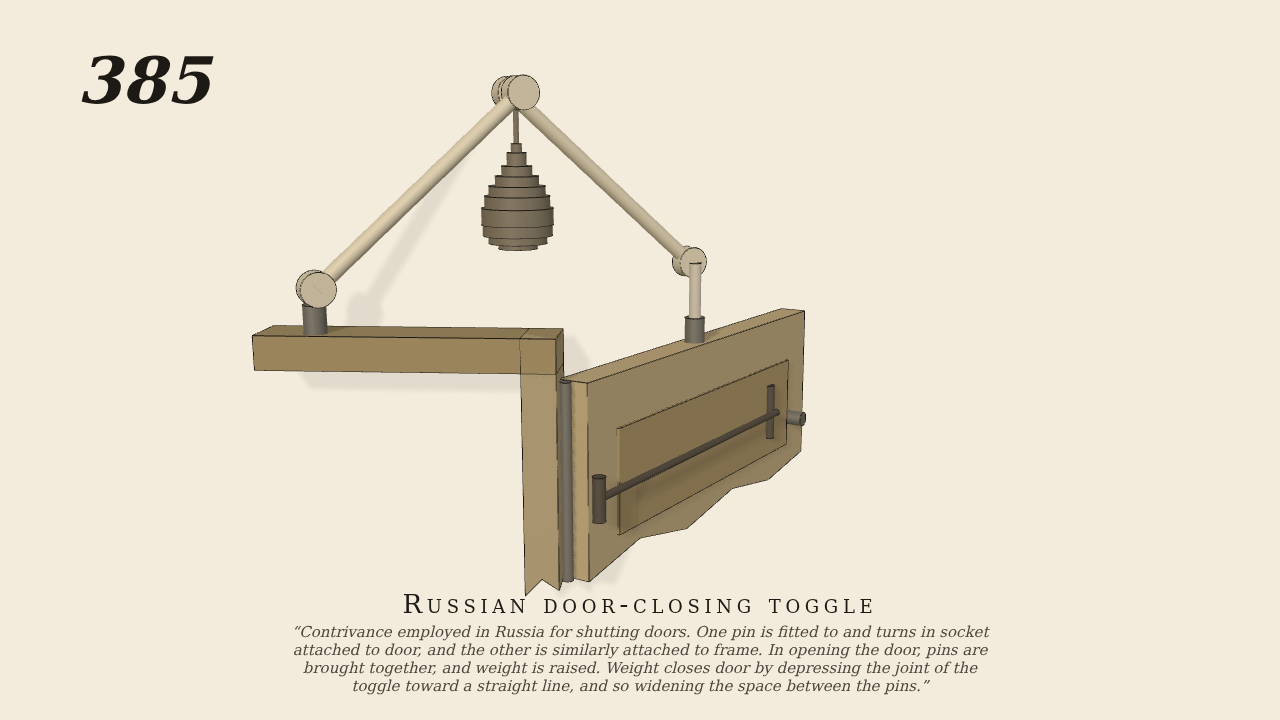
Contrivance employed in Russia for shutting doors. One pin is fitted to and turns in socket attached to door, and the other is similarly attached to frame. In opening the door, pins are brought together, and weight is raised. Weight closes door by depressing the joint of the toggle toward a straight line, and so widening the space between the pins.
Only the input is driven; every other part of this model moves by physics (MuJoCo), and its ratios are measured. Run it live, change its parameters, or switch the friction off to see the output stop.
- Modelled as
- Gravity on. A door 46 cm wide turns on an upright hinge and shuts against its stop. Two pins stand up in sockets, each free to turn: one on the door's top 22 cm from the hinge line, the other on the frame's head 22 cm the other side. The toggle's two 25 cm links are pinned to the pins' tops and to each other at the knee, and a 3 kg pear-shaped weight hangs from the knee on a hook. A hand (the only driven joint, a push-rod swung about the hinge line, ±1.2 rad at 0.1 Hz) presses on the door's face through a pad (real contact) and opens it. The hand only pushes: when it draws back, the weight alone closes the door.
- Measured
- The door rides the pad open to 1.08 rad (follow ratio 1.0 with the hand); the pins come together from 44 to about 36 cm and the knee, with the weight, rises about 5 cm. As the hand draws back the weight settles, straightens the toggle, spreads the pins and swings the door shut onto its stop by 5 s, where it stays (0 to 0.02 rad) while the hand swings away.
- Notes
- Brown gives no sizes and draws only the toggle and its weight; the door and its post are shown broken off below their top 18 cm (the door's full weight kept), so that the caption is clear of the model. The pins' sockets turn freely, as Brown says.
Film (MP4) · Still (PNG) · Spec (YAML) · Model (MJCF)