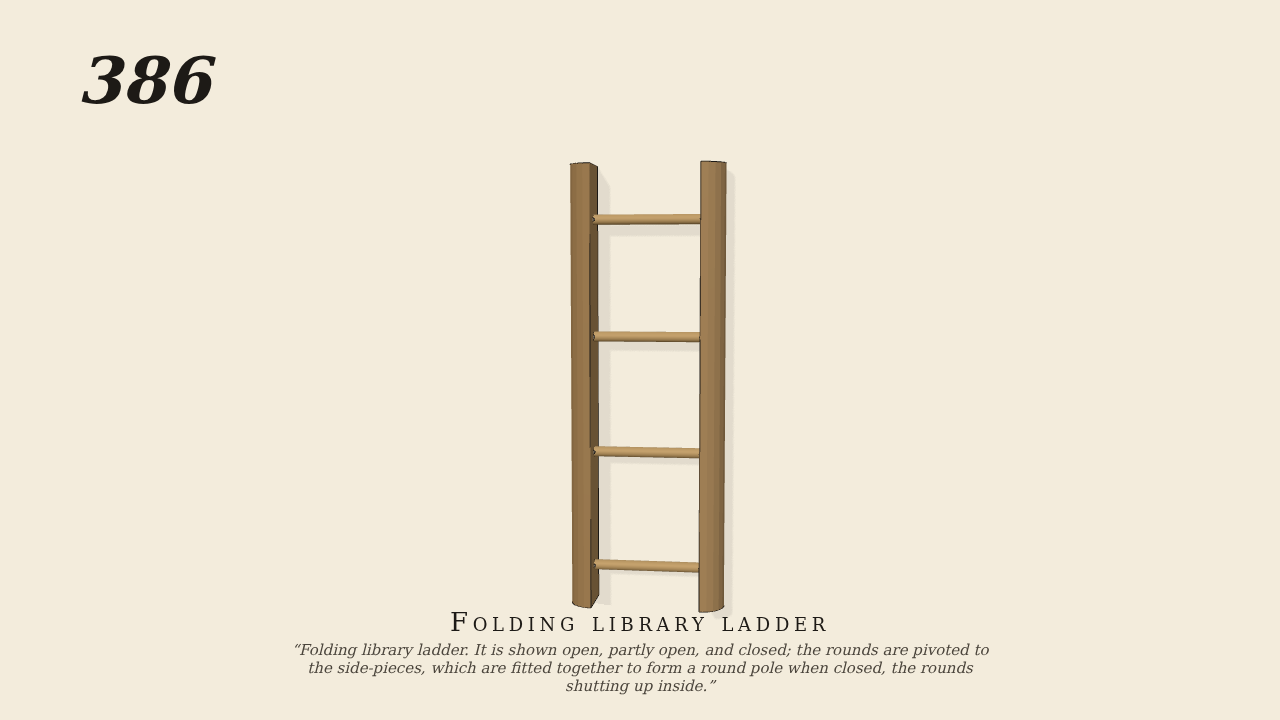
Folding library ladder
Folding library ladder. It is shown open, partly open, and closed; the rounds are pivoted to the side-pieces, which are fitted together to form a round pole when closed, the rounds shutting up inside.
Only the input is driven; every other part of this model moves by physics (MuJoCo), and its ratios are measured. Run it live, change its parameters, or switch the friction off to see the output stop.
- Modelled as
- Gravity on. Two side-pieces, each a half-round 114 cm long of radius 6, stand with their flat faces toward each other; four rounds 28 cm long are pivoted to both by pins in those faces. The left side-piece stands fixed and the right one hangs on the rounds alone. The hand (the only driven joint) swings the lowest round about its pivot, ±0.79 rad at 0.1 Hz from 0.8 rad (partly open). With the rounds level the ladder is open 28 cm wide. With them upright the right side-piece has risen 28 cm and come over against the left: the flat faces meet (a real contact, which stops the folding) and make a round pole 12 cm across, with the rounds standing up inside it.
- Measured
- The pinned rounds make parallelograms: every round turns with the lowest (follow ratio 1.000) and the right side-piece stays upright (-1.000). Open at 2.5 s (rounds 0.004 rad off level); shut at 7.5 s, the faces in contact with the rounds upright (1.571 rad).
- Notes
- Brown gives no sizes and shows the ladder open, partly open and closed side by side; the model shows one ladder going through all three in turn. The grooves in which the rounds lie when shut are not cut in the faces (the rounds are drawn but do not collide); the side-pieces' faces do collide.
Film (MP4) · Still (PNG) · Spec (YAML) · Model (MJCF)