Self-adjusting step-ladder for wharfs at which there are rise and…
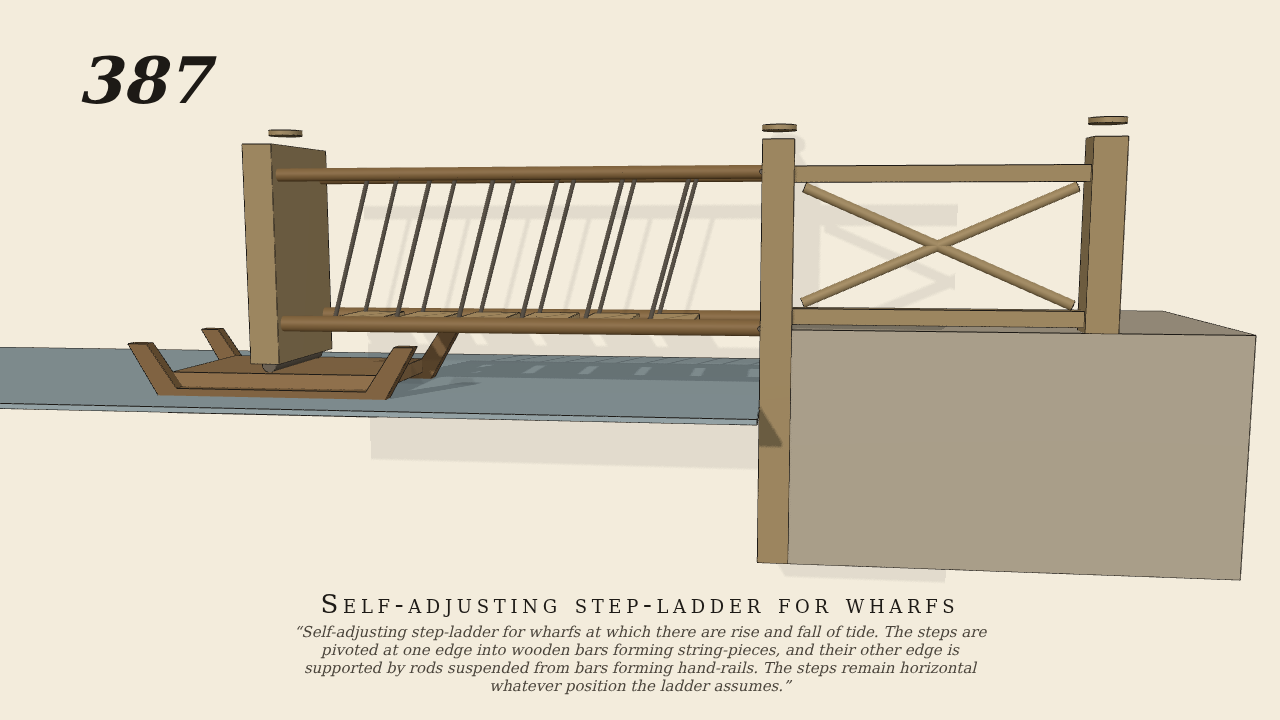
Self-adjusting step-ladder for wharfs at which there are rise and fall of tide. The steps are pivoted at one edge into wooden bars forming string-pieces, and their other edge is supported by rods suspended from bars forming hand-rails. The steps remain horizontal whatever position the ladder assumes.
Only the input is driven; every other part of this model moves by physics (MuJoCo), and its ratios are measured. Run it live, change its parameters, or switch the friction off to see the output stop.
- Modelled as
- Gravity on. Two string-pieces and two hand-rails, each 100 cm pivot to pivot, are pivoted to the wharf's post 30 cm apart and at their outer ends to a post standing in a boat, so string-piece, hand-rail and the two posts make a parallelogram and the outer post stays upright. Six steps (9 cm treads) are pivoted at one edge into the string-pieces; a rod hung from the hand-rail directly above each pivot holds the step's other edge, a triangle with an upright side of 30 cm, so the step stays level. The tide (the only driven joint) floats the boat up and down 20 cm about half tide at 0.1 Hz; the outer post's foot rests on the boat's floor (a real contact) and slides on it as the ladder swings.
- Measured
- At high water (2.5 s) the ladder lies level with the wharf (string-piece 0.002 rad off level); at low water (7.5 s) it slopes 0.417 rad (24 degrees). Throughout, the outer post and every step turn exactly against the string-piece (follow ratio -1.000), so the post stays upright and the steps stay level.
- Notes
- Brown gives no sizes and shows the ladder at high and at low water; the model goes from one to the other with the tide. The boat's hull and the water are drawn moving with the boat's floor and do not collide; the wharf is drawn as a block with its railing.
Film (MP4) · Still (PNG) · Spec (YAML) · Model (MJCF)