Anti-friction bearing for a pulley
Anti-friction bearing for a pulley.
Only the input is driven; every other part of this model moves by physics (MuJoCo), and its ratios are measured. Run it live, change its parameters, or switch the friction off to see the output stop.
- Modelled as
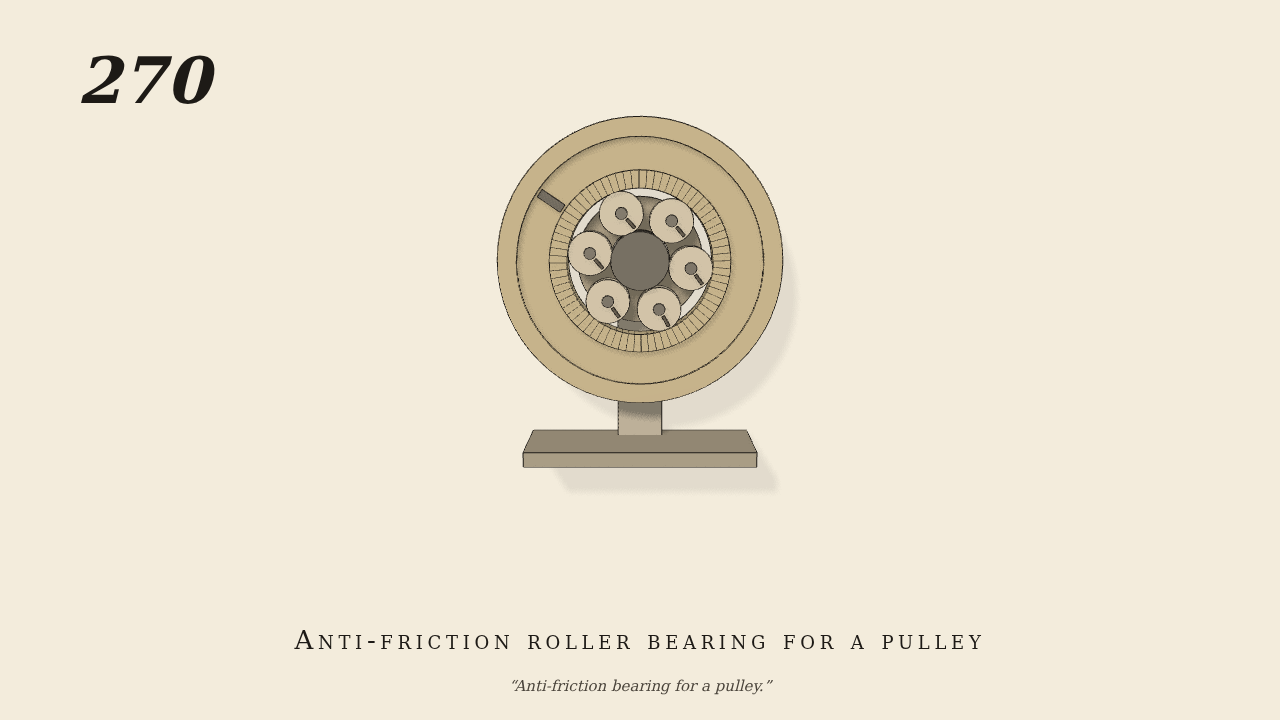
- The pulley (rim radius 9 cm, bore radius 5.03 cm) is the one driven joint, at 20 turns a minute. It has no bearing of its own. It hangs by its own weight on six rollers (radius 1.5 cm) lying round a fixed axle (radius 2 cm), and it is free to shift a little on two light slides, so its weight reaches the axle only through the rollers. The rollers' pins ride in radial slots of a cage that turns free on the axle and only keeps them apart. Rolling, the rollers carry the cage round at B/(2(A+r)) = 0.7186 of the pulley and turn on their pins at B/(2r) less that, 0.9581.
- Measured
- The cage goes round at 0.7197 of the pulley (ideal 0.7186, -0.15% slip). Two opposite rollers turn on their pins at 0.9401 and 0.9380 (ideal 0.9581, about 2% slip, mostly while they are unloaded at the top). The deepest contact is 0.06 mm.
- Notes
- Brown shows two views: the cage's face with its pins, and the rollers round the axle. Six rollers as drawn; there is a small clearance (0.03 cm) so the pulley's weight is carried by the lower rollers.
Film (MP4) · Still (PNG) · Spec (YAML) · Model (MJCF)