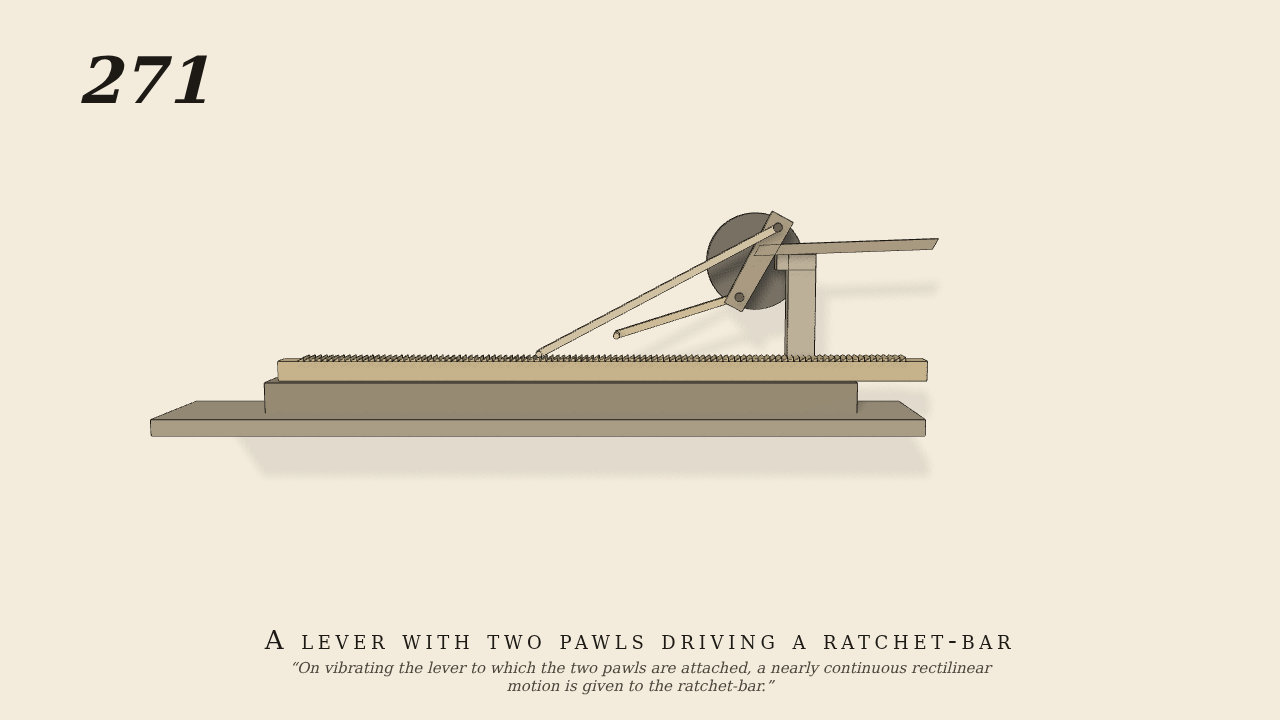
On vibrating the lever to which the two pawls are attached, a…
On vibrating the lever to which the two pawls are attached, a nearly continuous rectilinear motion is given to the ratchet-bar.
Only the input is driven; every other part of this model moves by physics (MuJoCo), and its ratios are measured. Run it live, change its parameters, or switch the friction off to see the output stop.
- Modelled as
- The hand-lever, pivoted on a post, is the one driven joint, rocked 0.5 rad each way twice in two seconds (0.5 Hz). A small steel hand-wheel on its arbor steadies it. Two pawls hang from it on pins 2 cm above and 2 cm below its pivot, so as it rocks one pin goes back while the other goes forward, each through 1.92 cm. Each pawl lies by its own weight and a light spring on the ratchet-bar's teeth (pitch 0.3 cm, vertical faces toward the lever). It pushes the bar to the left on its stroke and slips back over the teeth on the other, so the bar goes on at every stroke of the lever, either way. The bar works against a drag on its slide (20 N s/m). Only the pawls' tips touch the teeth.
- Measured
- The bar advances 1.713 cm per stroke of the lever over 7 strokes (ideal 1.918 cm, a pin's stroke, less up to one tooth's pickup: 1.768 ±11%). It never runs back more than 0.086 cm, under half a tooth: net 12.8 cm in 7.5 s. The deepest contact is 0.11 mm.
- Notes
- Brown gives no sizes. The pins are set symmetrically above and below the pivot as drawn. The bar's run-back comes at each turn of the lever, when the returning pawl drags it before the other takes hold.
Film (MP4) · Still (PNG) · Spec (YAML) · Model (MJCF)