Rotary motion of the beveled disk cam gives a reciprocating…
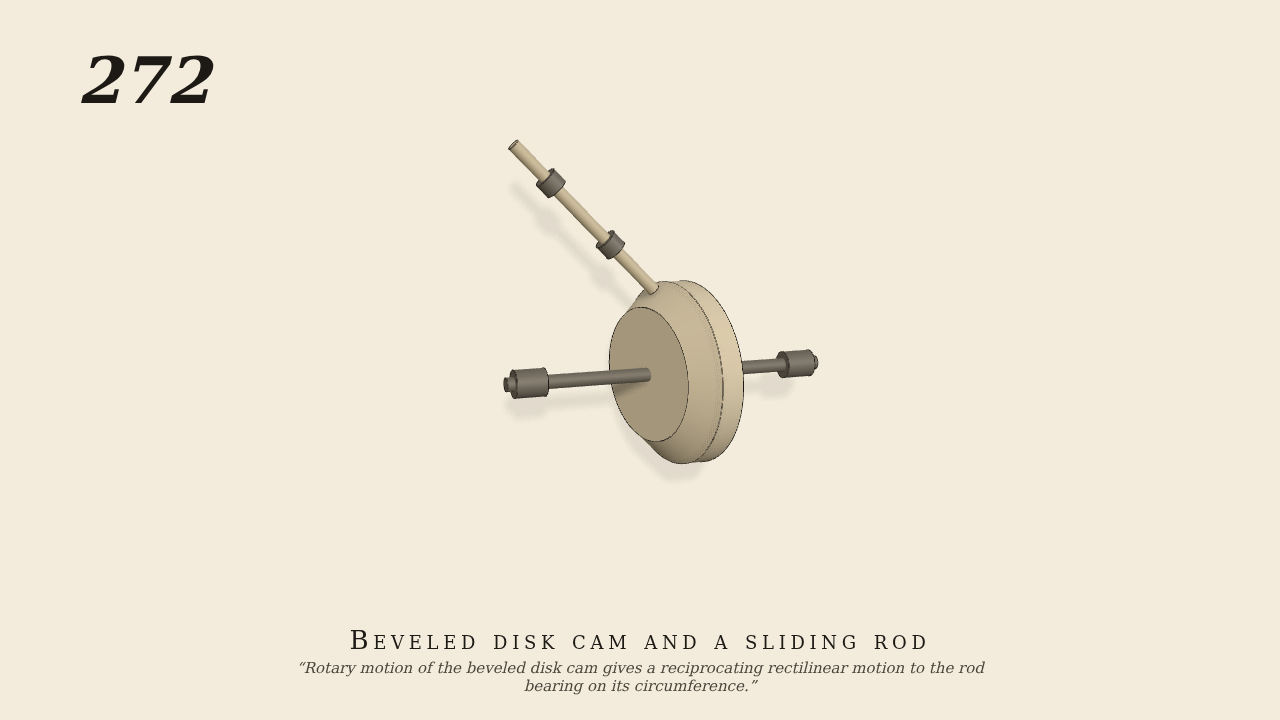
Rotary motion of the beveled disk cam gives a reciprocating rectilinear motion to the rod bearing on its circumference.
Only the input is driven; every other part of this model moves by physics (MuJoCo), and its ratios are measured. Run it live, change its parameters, or switch the friction off to see the output stop.
- Modelled as
- A steel disk (radius 6 cm) is keyed askew on a horizontal shaft, the one driven joint, at 30 turns a minute. Its left face runs 1 cm either way of its mean plane at the rim, and that edge is beveled at 45 degrees (1.6 cm deep). A rod slides freely in two guides set up and to the left at 45 degrees. It rests by its own weight with its rounded end square on the bevel at the top. As the disk turns, the askew bevel moves 2 cm to and fro under the rod's end, so the rod slides up and down its guides through 2/√2 = 1.414 cm, one stroke each way per turn. Only the bevel touches the rod.
- Measured
- The rod's stroke is 0.000 to 1.414 cm (ideal 1.414), a half-stroke of 0.707 cm (ideal 0.707 ±5%). The disk turns 3.1417 rad per stroke of the rod over 6 strokes (ideal π ±3%). The deepest contact is 0.002 mm.
- Notes
- Brown draws the face as a gentle S. Here it is a plane set askew, which gives the plainest harmonic stroke. The rod is held to the cam by its weight alone; its acceleration at 30 rpm is far below g/√2, so it never leaves the bevel.
Film (MP4) · Still (PNG) · Spec (YAML) · Model (MJCF)