Rectilinear into rectilinear motion
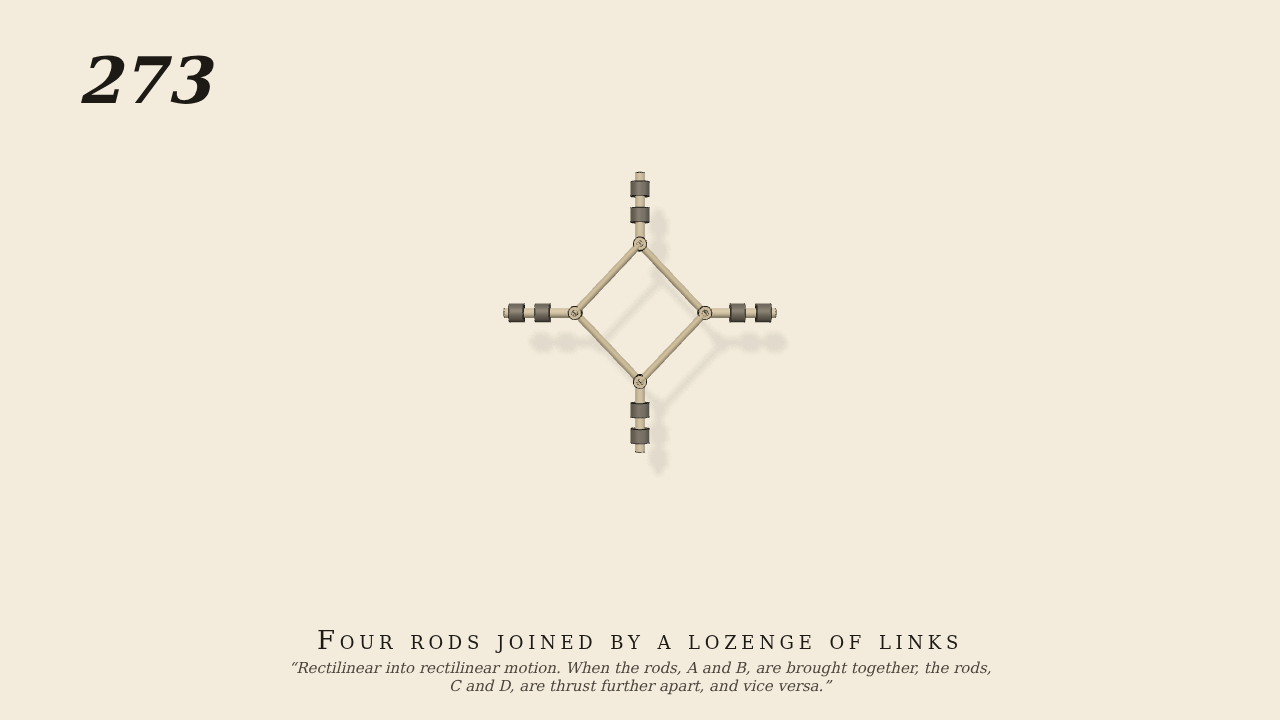
Rectilinear into rectilinear motion. When the rods, A and B, are brought together, the rods, C and D, are thrust further apart, and vice versa.
Only the input is driven; every other part of this model moves by physics (MuJoCo), and its ratios are measured. Run it live, change its parameters, or switch the friction off to see the output stop.
- Modelled as
- Four rods slide in fixed guides: A and B on a level line, C and D on an upright one. Their inner ends are joined by four equal links (8 cm eye to eye), pinned at studs on the rods, making a lozenge that is square at the start. Rod A is the one driven joint, pushed in and drawn out 1.5 cm each way, 0.4 times a second. Nothing else is driven. The links carry B in as A goes in, and thrust C up and D down, so C stands at √(L² − x_A²) from the centre. Gravity is on, upright as drawn.
- Measured
- B follows A at slope −1.0000 (r² 1.0000) and D follows C at −0.9997 (ideal −1 ±2%). C runs −2.078 to +1.175 cm from its start (ideal −2.082 to +1.178 for A's full stroke), within 0.001 cm of √(L² − x_A²) for A's measured position. Over the whole stroke C moves 1.0637 cm per cm of A by least squares (ideal 1.0626 ±3%), 1.000 at the square.
- Notes
- Brown gives no sizes; the links are equal and the lozenge square at mid-stroke. The 'vice versa' is the same machine run backward: as A is drawn out, B goes out and C and D come together. A stiff drive (kv 200) holds A's stroke within 0.5% against the weight of C and D.
Film (MP4) · Still (PNG) · Spec (YAML) · Model (MJCF)