An engine-governor
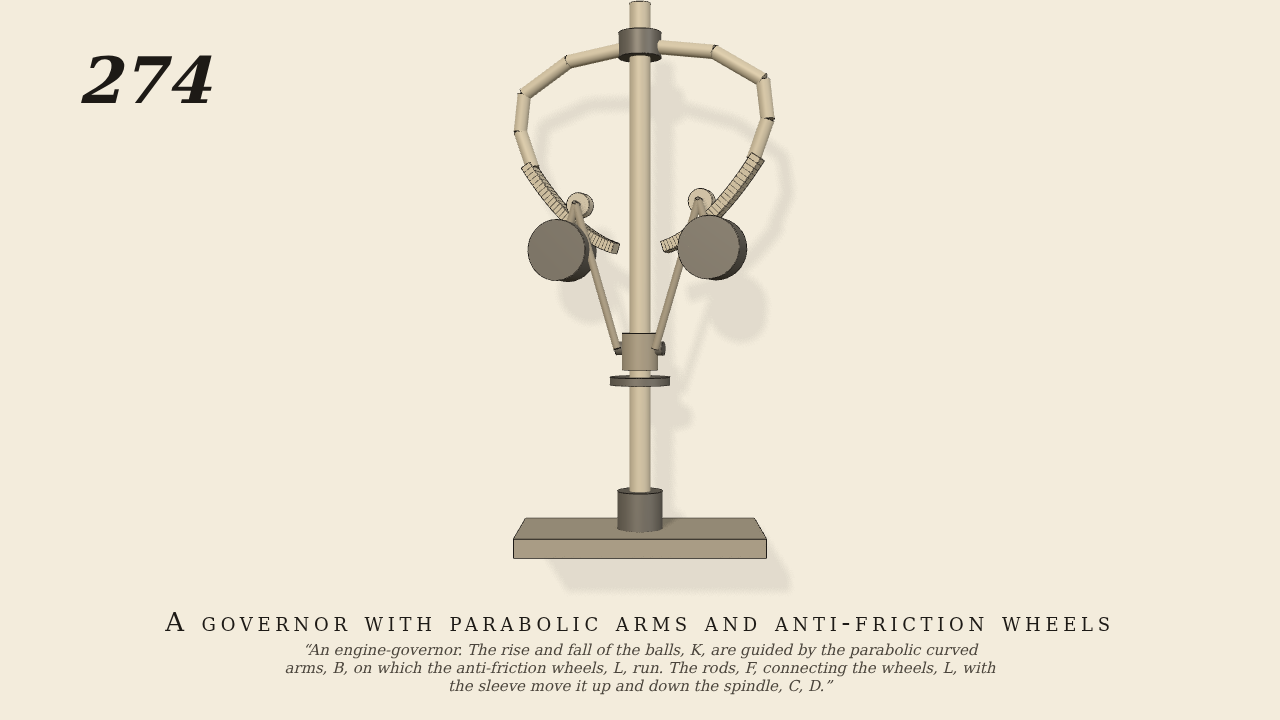
An engine-governor. The rise and fall of the balls, K, are guided by the parabolic curved arms, B, on which the anti-friction wheels, L, run. The rods, F, connecting the wheels, L, with the sleeve move it up and down the spindle, C, D.
Only the input is driven; every other part of this model moves by physics (MuJoCo), and its ratios are measured. Run it live, change its parameters, or switch the friction off to see the output stop.
- Modelled as
- The spindle C D is the one driven joint, at 165 turns a minute. It carries two arms B whose running faces are the parabola z = 20 + x²/10 cm. On each face runs an anti-friction wheel L (radius 0.8 cm). Its axle is at the top of a rod F (10 cm), pinned at its foot to the sleeve, which slides on the spindle with a light dashpot. The ball K (0.4 kg with its rod) hangs from the wheel's axle. Nothing else is driven. As the spindle runs up, the balls fly out, the wheels climb the arms, and the rods lift the sleeve until the spin and the weights balance. Only the wheels' contact with the arms guides them.
- Measured
- Through the rise and its settling (0.6 to 1.6 s), the sleeve rises 0.1091 m per radian of rod. The ideal is 0.1128 ±5%, from the wheel's centre held on the curve parallel to the parabola. The wheel's centre stays 0.80 cm (its radius) from the parabola. The two rods move alike (slope 0.9942, r² 0.9998). From 3 s on, the rods stand out 0.194 rad and the sleeve stands 1.62 cm up. The deepest contact is 0.03 mm.
- Notes
- Brown gives no sizes. With a parabola of parameter 5 cm, a point mass would float at any height at √(g/p) = 134 rpm, which is the parabolic governor's isochronism. The balls hang outboard of the wheels, and the sleeve and rods add their weight, so here the balls find a stable height that rises steeply with speed.
Film (MP4) · Still (PNG) · Spec (YAML) · Model (MJCF)