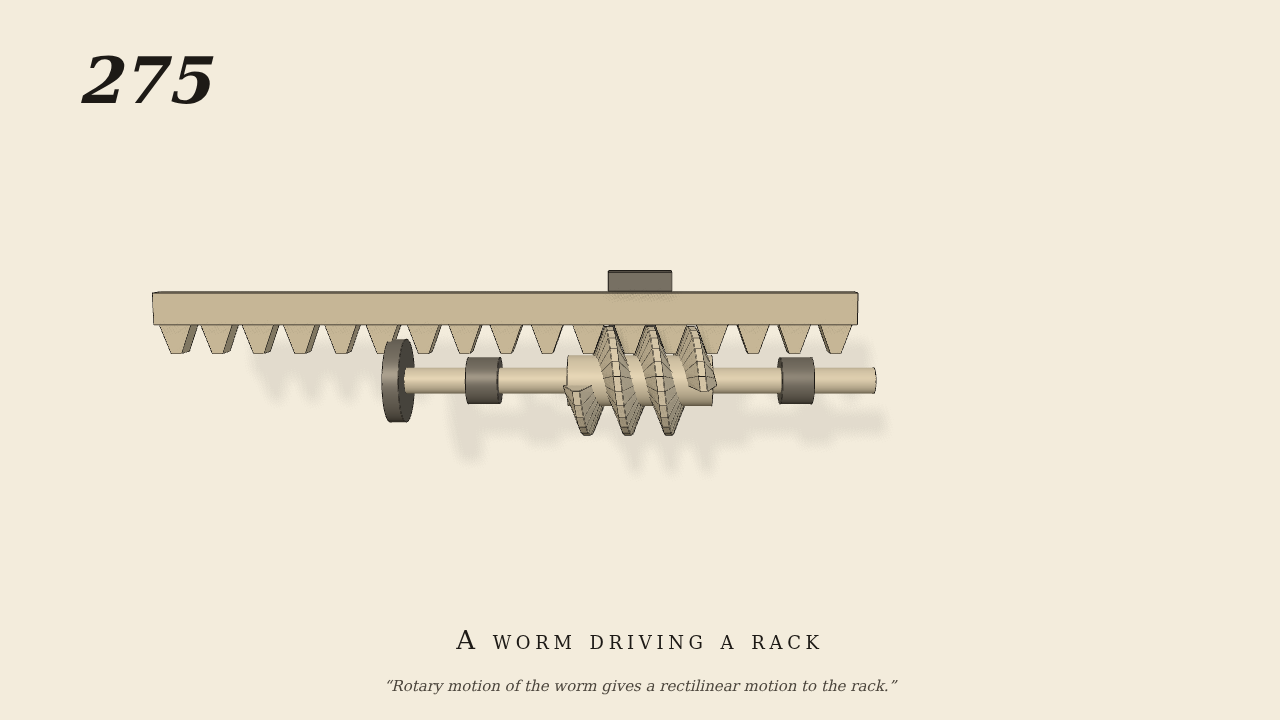
Rotary motion of the worm gives a rectilinear motion to the rack
Rotary motion of the worm gives a rectilinear motion to the rack.
Only the input is driven; every other part of this model moves by physics (MuJoCo), and its ratios are measured. Run it live, change its parameters, or switch the friction off to see the output stop.
- Modelled as
- The worm is No. 31's: a single right-hand thread of three turns, axial pitch π·0.5 = 1.571 cm, on a shaft along x. It is the one driven joint, at 60 turns a minute. Over it lies a straight rack of 17 teeth at the same pitch, with 20° flanks, 0.75 cm thick at the pitch line. The rack is held in a guide that lets it slide only along x, against a light drag. Only the thread touches the rack's teeth. Each turn of the worm, the thread at its top advances one pitch along x and pushes the rack one tooth.
- Measured
- Over 0.5 to 5.5 s, the rack moves −0.0025 m per radian of worm (r² 1.0000). The ideal is −1.571 cm per turn, −0.0025 m/rad ±2%. The sign follows from the hand of the thread: the rack runs to the left as the worm turns +x. In six turns it travels 9.4 cm. The deepest contact is 0.002 mm.
- Notes
- Brown draws the rack upright beside the worm. Here it lies flat over the worm, in No. 31's layout. It is the same mechanism turned a quarter turn.
Film (MP4) · Still (PNG) · Spec (YAML) · Model (MJCF)