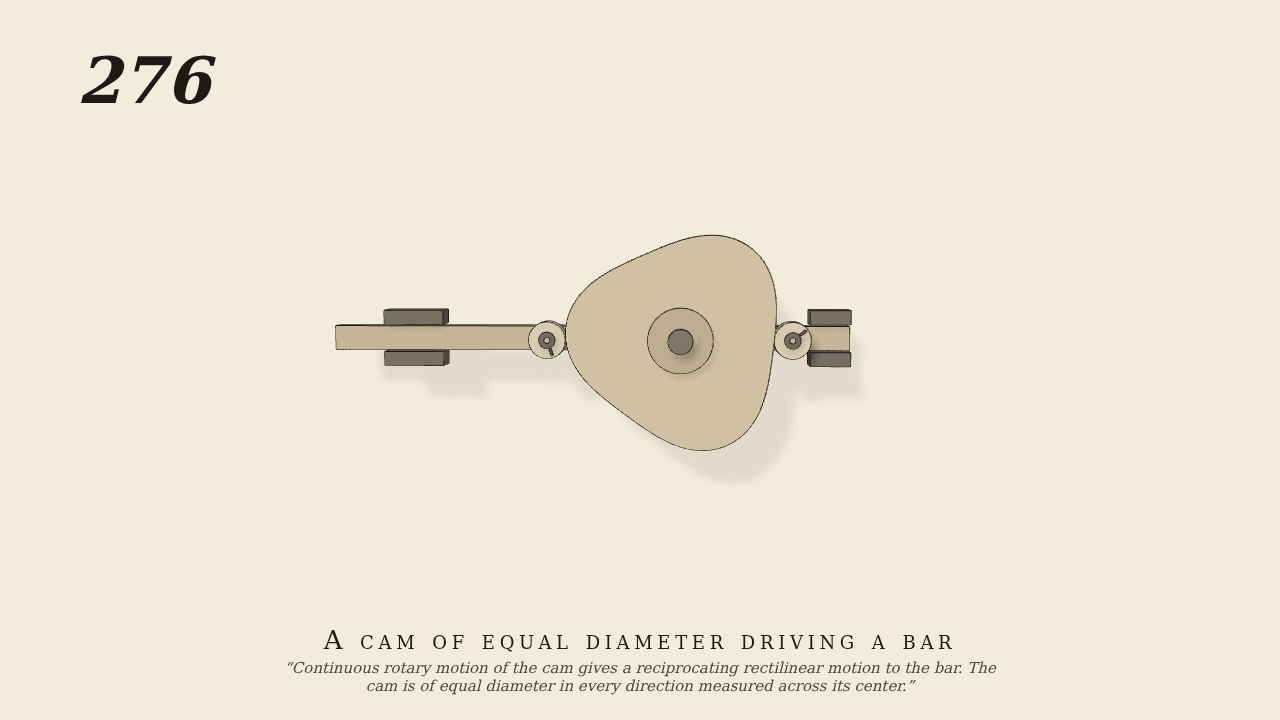
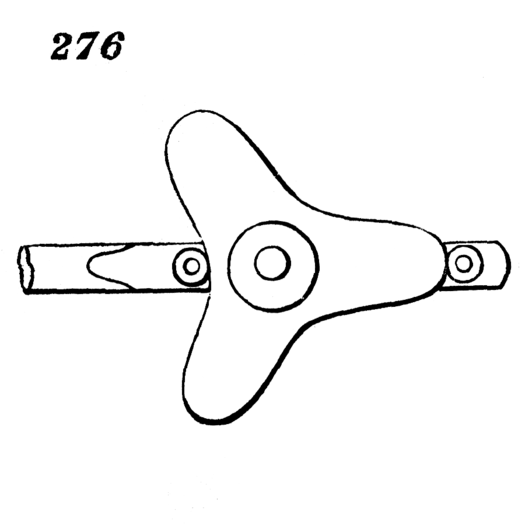
Continuous rotary motion of the cam gives a reciprocating…
Continuous rotary motion of the cam gives a reciprocating rectilinear motion to the bar. The cam is of equal diameter in every direction measured across its center.
Only the input is driven; every other part of this model moves by physics (MuJoCo), and its ratios are measured. Run it live, change its parameters, or switch the friction off to see the output stop.
- Modelled as
- A three-lobed cam on a shaft along y is the one driven joint, at 30 turns a minute. A bar slides along x in two guides. It carries two rollers (radius 0.9 cm) on studs, one each side of the cam, with their centres 12.04 cm apart. The rollers' path round the cam is r(t) = 6 + 0.55 sin 3t cm in polar form, and the cam's profile lies 0.9 cm inside it. Since r(t) + r(t + π) = 12 cm, the cam measures the same across its centre in every direction. It holds both rollers at once, with 0.02 cm play each side, and drives the bar both ways with no spring. Only the cam's contact with the rollers moves the bar.
- Measured
- From 0.5 s on, the bar follows x = 0.55 sin 3φ cm to within 0.014 cm rms (0.028 cm at most, about the play). That gives three double strokes per turn of the cam. Half the stroke is 0.573 cm, the ideal 0.55 plus the play. The bar stays between −0.571 and 0.575 cm. The deepest contact is 0.02 mm.
- Notes
- Brown gives no sizes, and his cam's flanks are hollow. Here the lobes are kept low (0.55 < 6/10) so the cam stays convex; a sharper cam would need hollow flanks. The equal diameter is measured along the line of the two rollers through the cam's centre, which is what a roller follower needs.
Film (MP4) · Still (PNG) · Spec (YAML) · Model (MJCF)