Col
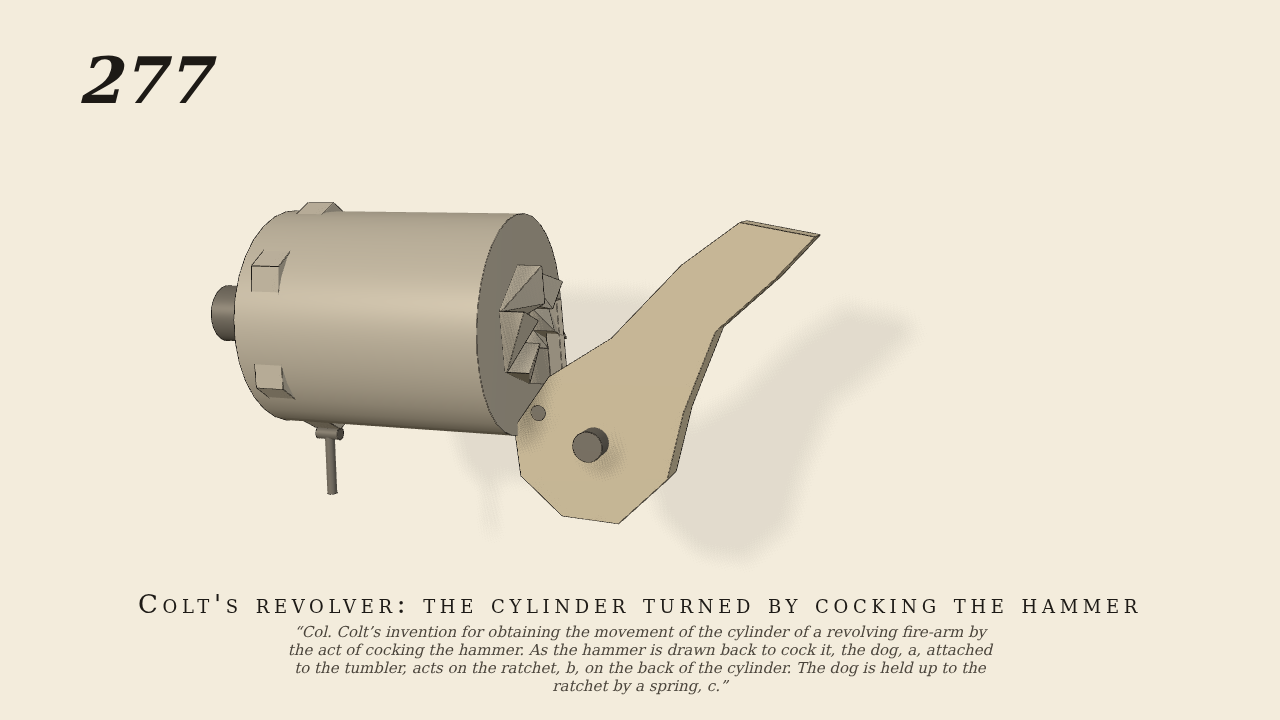
Col. Colt’s invention for obtaining the movement of the cylinder of a revolving fire-arm by the act of cocking the hammer. As the hammer is drawn back to cock it, the dog, a, attached to the tumbler, acts on the ratchet, b, on the back of the cylinder. The dog is held up to the ratchet by a spring, c.
Only the input is driven; every other part of this model moves by physics (MuJoCo), and its ratios are measured. Run it live, change its parameters, or switch the friction off to see the output stop.
- Modelled as
- Gravity on. Brown's figure shows the back of a revolver's cylinder with the ratchet b on its face, the hammer and its tumbler behind it, and the dog a hung on the tumbler, held up to the ratchet by the spring c. Here the cylinder turns on an axis along x. The ratchet on its back face has 6 teeth, one a chamber, each a ramp rising 0.6 to a steep face. Each tooth is a single convex solid, so the ramp is one smooth surface. The hammer turns on a pin along y behind and below the cylinder. It is the one driven joint: drawn back and let forward 0.42 rad each way, half a cycle a second. The dog hangs on a pin on the tumbler, 1 to the side of the cylinder's axis. A joint spring (c) holds its rounded tip forward onto the ratchet. Cocking lifts the tip, which lifts the steep face over it and turns the cylinder a sixth of a turn. Letting the hammer down, the tip rides down the next ramp against the spring and drops in behind the next tooth. A light bolt under the cylinder, a slide pressed up by a spring, rides a six-notched star on the cylinder's front. A little friction on the cylinder's axis holds it between strokes. Only the dog's contact with the ratchet turns the cylinder.
- Measured
- The cylinder goes 0.5231 rad per beat (a twelfth of a turn, 0.5236 expected; a sixth of a turn each full cocking) over 8 beats. It does the same with the hammer worked 0.4 or 0.6 times a second, with a 0.5 rad stroke, with a stiffer dog spring, or with less axis friction (0.002). After the first half second the deepest contact is 0.31 mm.
- Notes
- Brown gives no sizes. An earlier try built each tooth from six convex slices; the tip caught on the ridges between slices (0.66 mm deep) and the cylinder advanced erratically. Single-solid teeth fixed that. The bolt is deliberately light. Twice its spring force stops the dog short of a full sixth of a turn, so it does not lock the cylinder the way a real Colt bolt does. The cylinder rests about 4° short of each chamber position, held there by its axis friction.
Film (MP4) · Still (PNG) · Spec (YAML) · Model (MJCF)