C. R. Otis’s safety-stop for the platform of a hoisting apparatus
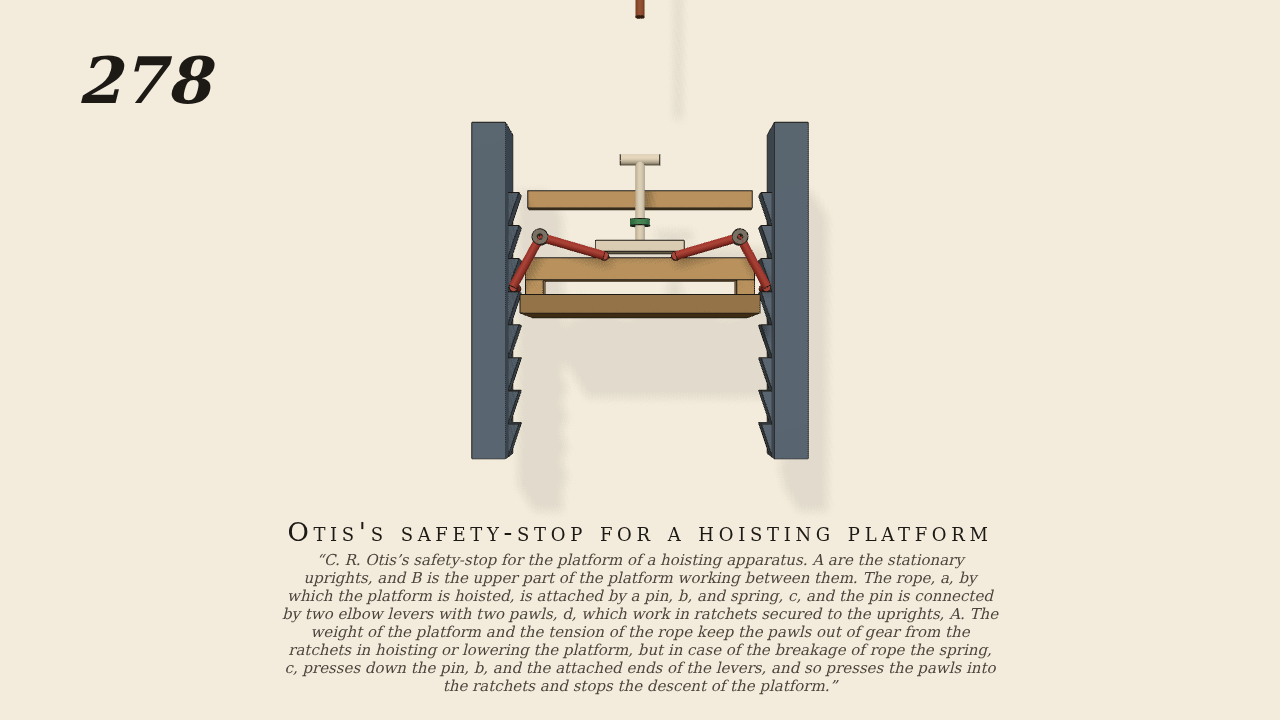
C. R. Otis’s safety-stop for the platform of a hoisting apparatus. A are the stationary uprights, and B is the upper part of the platform working between them. The rope, a, by which the platform is hoisted, is attached by a pin, b, and spring, c, and the pin is connected by two elbow levers with two pawls, d, which work in ratchets secured to the uprights, A. The weight of the platform and the tension of the rope keep the pawls out of gear from the ratchets in hoisting or lowering the platform, but in case of the breakage of rope the spring, c, presses down the pin, b, and the attached ends of the levers, and so presses the pawls into the ratchets and stops the descent of the platform.
Only the input is driven; every other part of this model moves by physics (MuJoCo), and its ratios are measured. Run it live, change its parameters, or switch the friction off to see the output stop.
- Modelled as
- The platform B (0.5 kg) slides up and down between two uprights A. Each upright's inner face carries a ratchet with flat-topped teeth 0.5 cm deep at 1.5 cm pitch. The rope a is the one driven joint: it is wound up at 2 cm/s and hoists the platform. Its lower end is a stirrup under the head of the pin b. The pin slides in the platform, and the spring c (a joint spring) pushes it down. Its collar rests on the inner ends of two elbow levers pivoted on the platform. The outer arm of each lever ends in a pawl d, and light springs on the levers hold the pawls out of gear. At 4.3 s the rope breaks just above the stirrup, and the broken end falls away.
- Measured
- For 4.2 s the rope hoists the platform about 7.9 cm. The platform's weight holds the pin up against the spring (0.001 cm from its stop), so the pawls stay clear. When the rope breaks, the spring c drives the pin 0.92 cm down and the levers turn 0.28 rad, throwing both pawls into the ratchets. The platform drops about 1 cm and is caught on the next tooth, at 6.945 cm. From 4.45 s to the end it does not move (0.0000 cm). The deepest contact is 0.22 mm.
- Notes
- Brown gives no sizes. The break is modelled with a joint spring that holds the stirrup to the rope until 4.3 s, when a hand schedule moves the spring's free position 40 cm down, so the broken end falls away. The drum stays the only driven joint. The pawls bear on the flat tops of the teeth and ride up their sloping faces, which is what lets the platform be hoisted with the pawls out. In the video, 4.2 to 4.7 s plays at a quarter of real speed, as labelled.
Film (MP4) · Still (PNG) · Spec (YAML) · Model (MJCF)