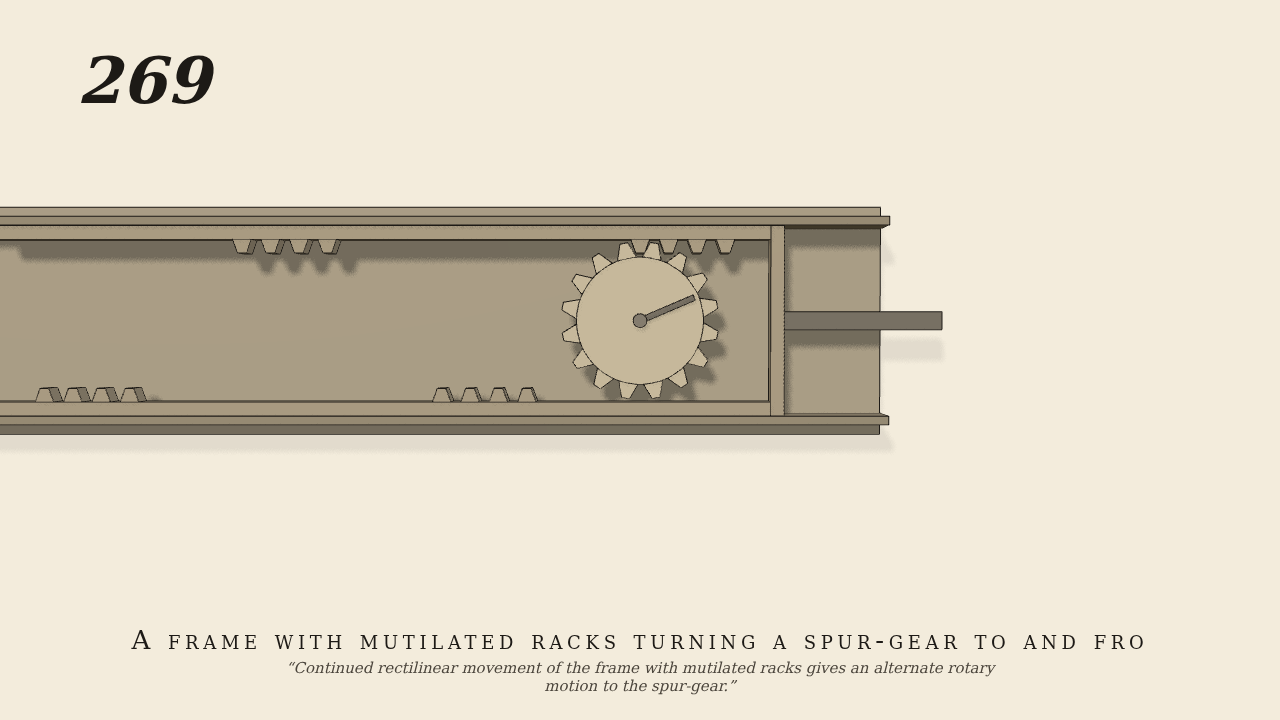
Continued rectilinear movement of the frame with mutilated racks…
Continued rectilinear movement of the frame with mutilated racks gives an alternate rotary motion to the spur-gear.
Only the input is driven; every other part of this model moves by physics (MuJoCo), and its ratios are measured. Run it live, change its parameters, or switch the friction off to see the output stop.
- Modelled as
- The frame is the one driven joint, drawn steadily to the right at 3 cm/s. Its top and bottom bars carry racks facing in (module 0.8, No. 114's straight-flanked teeth), cut away but for groups of four teeth, top and bottom in turn, four pitches apart. A full spur-gear (16 teeth, pitch radius 6.4 cm) turns on a fixed shaft between them with a light drag. A top group turns it forward, it stands while the frame runs through the gap, and the next bottom group turns it back the same amount. The groups are spaced so each one's first tooth enters a space where the last group left the gear. Only tooth contact turns the gear.
- Measured
- While the top teeth are in mesh the gear follows the frame at 15.607 and 15.598 rad/m; while the bottom teeth are in mesh it follows at -15.603 and -15.596 (ideal ±1/R = ±15.625, r2 0.9998). In the three gaps its mean speed is at most 0.0002 rad/s. It swings between -0.405 and 1.584 rad over two forward-and-back cycles, the same each cycle. The deepest contact is 0.02 mm.
- Notes
- Brown gives no sizes or tooth counts. Four teeth to a group; each tooth stays in mesh about 1.5 pitches either side of the gear's centre line, so each group after the first turns the gear 1.99 rad (114 degrees). The first group starts already in mesh and turns it 1.58 rad. Plan view of the frame's face, gravity off.
Film (MP4) · Still (PNG) · Spec (YAML) · Model (MJCF)