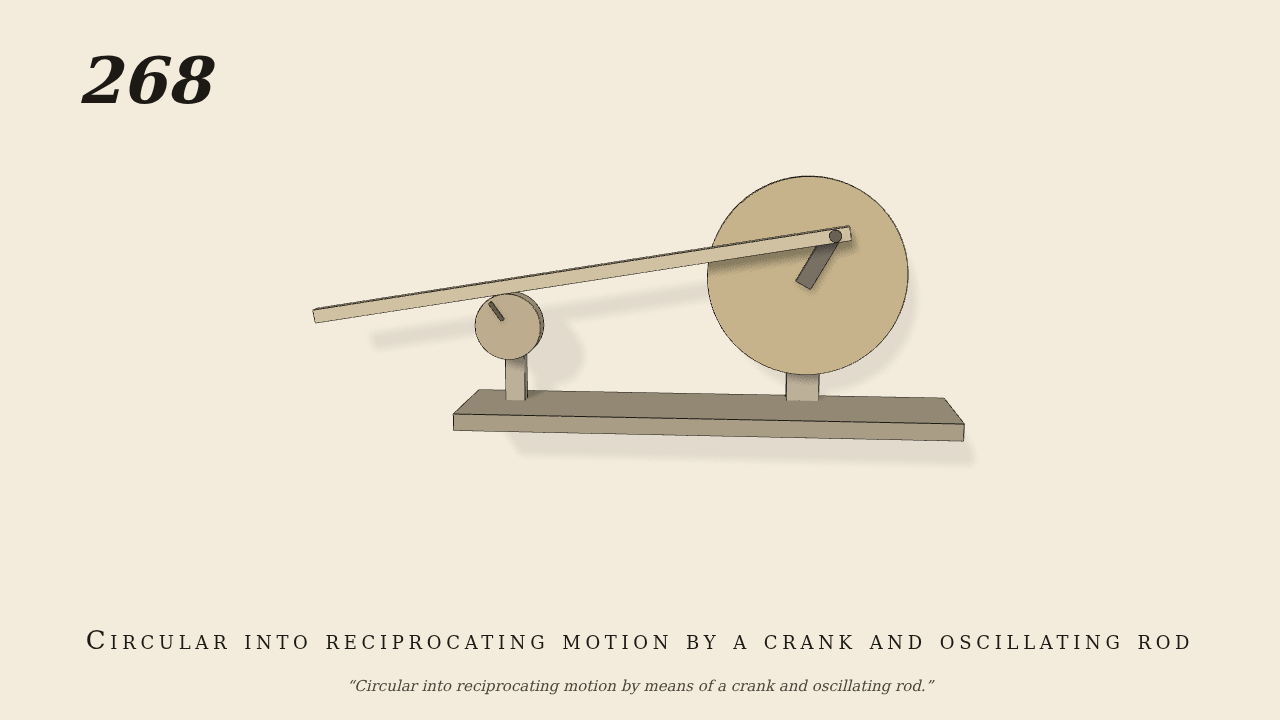
Circular into reciprocating motion by means of a crank and…
Circular into reciprocating motion by means of a crank and oscillating rod.
Only the input is driven; every other part of this model moves by physics (MuJoCo), and its ratios are measured. Run it live, change its parameters, or switch the friction off to see the output stop.
- Modelled as
- The disc's crank (radius 3 cm) is the one driven joint, at 20 turns a minute. A rod 32 cm long is pinned to the crank-pin and lies by its own weight on a free roller (radius 2 cm) 18 cm from the disc's centre. As the crank goes round, the rod slides to and fro over the roller and rocks on it through 19 degrees. Its far end goes to and fro 6.0 cm along its length and rises and falls 4.8 cm. The roller turns with the rod's sliding. Only the rod's contact with the roller holds it up.
- Measured
- The rod's angle on its pin follows the tangent-line geometry. At its fastest swing with the crank's turn the slope is -0.8587 (ideal -0.8586, r2 1.000), and at its fastest swing the other way it is -1.1944 (ideal -1.1954, r2 1.000). The rod never turns over: over 0.5 to 7.0 s it falls back -0.998 of a turn on its pin per turn of the crank. The roller rocks between -3.010 and 0.000 rad (ideal -3.009 to 0.018, the rod's slide over the roller's radius), with no drift over 3.75 turns. The deepest contact is under 0.01 mm.
- Notes
- Brown gives no sizes. The roller is free on its stud; the rod turns it by friction (mu 0.5) as it slides over it.
Film (MP4) · Still (PNG) · Spec (YAML) · Model (MJCF)