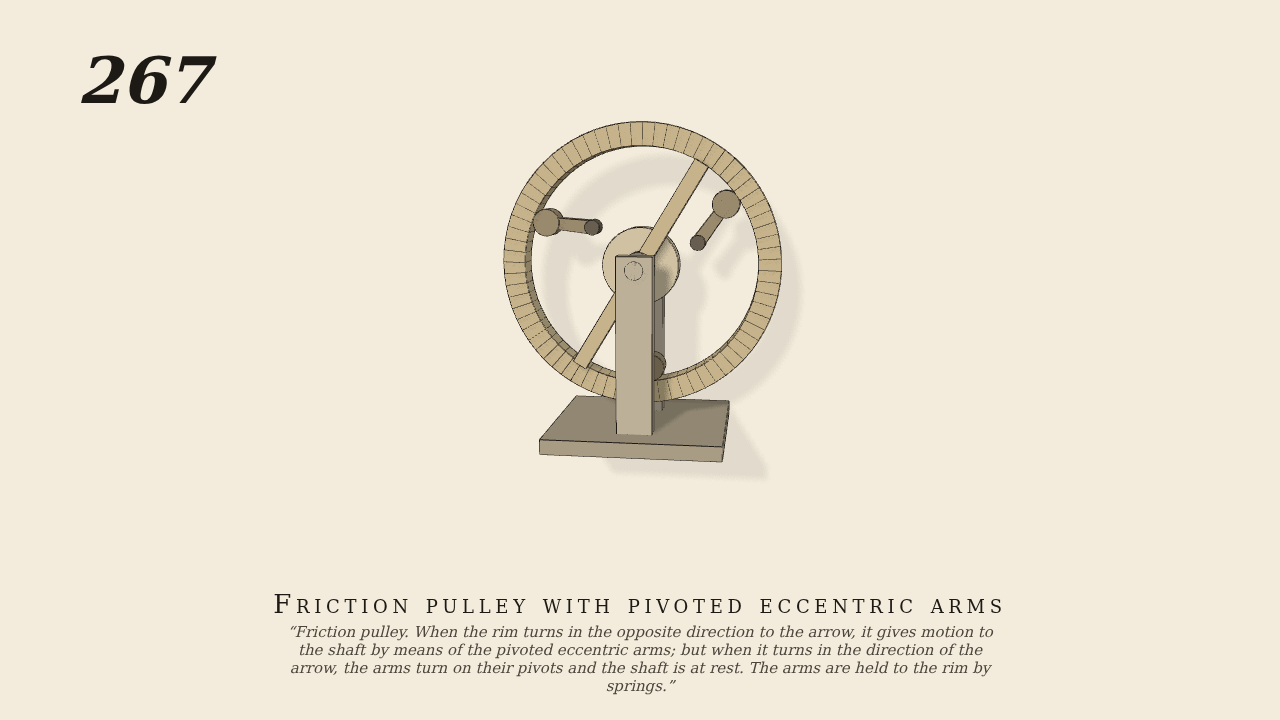
Friction pulley
Friction pulley. When the rim turns in the opposite direction to the arrow, it gives motion to the shaft by means of the pivoted eccentric arms; but when it turns in the direction of the arrow, the arms turn on their pivots and the shaft is at rest. The arms are held to the rim by springs.
Only the input is driven; every other part of this model moves by physics (MuJoCo), and its ratios are measured. Run it live, change its parameters, or switch the friction off to see the output stop.
- Modelled as
- The rim (inner radius 8 cm) is the one driven joint, rocked 0.6 rad each way once every two seconds by hand. Three arms, pivoted on the shaft's hub 4.2 cm from the centre, reach out to it. Each ends in a round eccentric toe (radius 0.9 cm) held to the rim by a light spring. Each arm leans 18 degrees from the rim's normal, less than the friction angle (mu 0.45), so turned one way the rim drags the toes up the lean, the arms wedge, and the shaft goes with it. Turned the other way it drags them off the lean, the arms turn on their pivots and slip, and the shaft is at rest. The shaft works against a load (3 N m s/rad) and goes on one stroke in two. Only the toes touch the rim.
- Measured
- Against the arrow the shaft follows the rim at 0.992 (ideal 1, r2 1.000). With the arrow, with the rim turning back at up to 1.9 rad/s, the shaft's mean speed is 0.017 rad/s. It advances 0.571 rad per beat of the rim (ideal 0.6, the rim's amplitude) and runs back at most 0.017 rad: net 3.98 rad over six beats. The deepest contact is 0.14 mm.
- Notes
- Brown gives no sizes or arm count; three arms at 120 degrees. The rim is rocked to and fro so the one run shows both directions. The arm springs are light (0.05 N m/rad) so the slipping toes drag little on the back stroke, and the shaft's load holds it there.
Film (MP4) · Still (PNG) · Spec (YAML) · Model (MJCF)