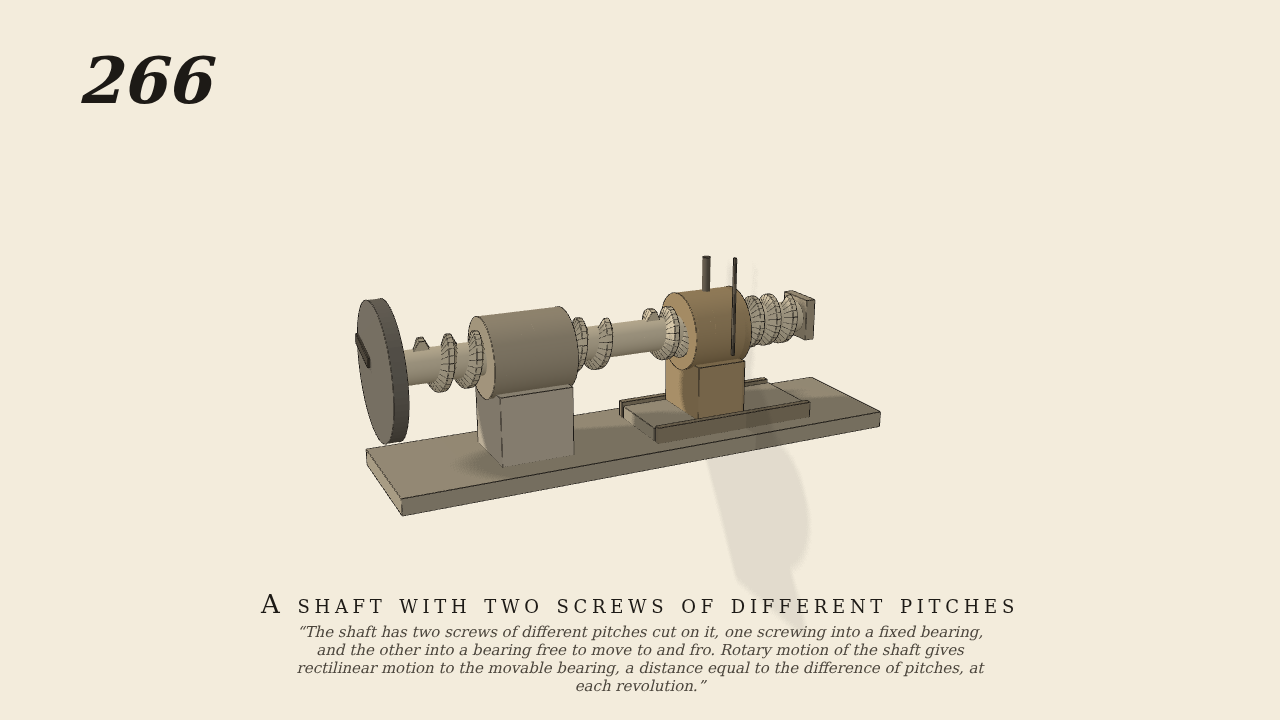
The shaft has two screws of different pitches cut on it, one…
The shaft has two screws of different pitches cut on it, one screwing into a fixed bearing, and the other into a bearing free to move to and fro. Rotary motion of the shaft gives rectilinear motion to the movable bearing, a distance equal to the difference of pitches, at each revolution.
Only the input is driven; every other part of this model moves by physics (MuJoCo), and its ratios are measured. Run it live, change its parameters, or switch the friction off to see the output stop.
- Modelled as
- The shaft (the one driven joint, turned at 20 turns a minute through a hand-wheel) has a screw of pitch 1.6 cm cut on one end and of 1.2 cm on the other, the same hand. The first works in a fixed bearing (a two-turn nut), so the shaft screws itself 1.6 cm along its axis each turn, free in its carriage. The second works in the movable bearing, a nut on a slide kept from turning. The shaft carries it 1.6 cm a turn and screws it back 1.2, so it moves 0.4 cm a turn, the difference of the pitches. Only the threads touch.
- Measured
- The shaft travels -0.002547 m per radian (ideal -0.002546, r2 1.000). The movable bearing travels -0.000637 m per radian (ideal -0.000637, r2 1.000), so 0.40 cm a turn against the shaft's 1.60. The deepest contact is 0.03 mm.
- Notes
- Brown gives no sizes. A light spring on the bearing's slide (about 10 N, resisting its travel) keeps it on one flank of its thread. Without it, the unloaded nut rattles in the thread's clearance and moves in jerks.
Film (MP4) · Still (PNG) · Spec (YAML) · Model (MJCF)