Variable motion
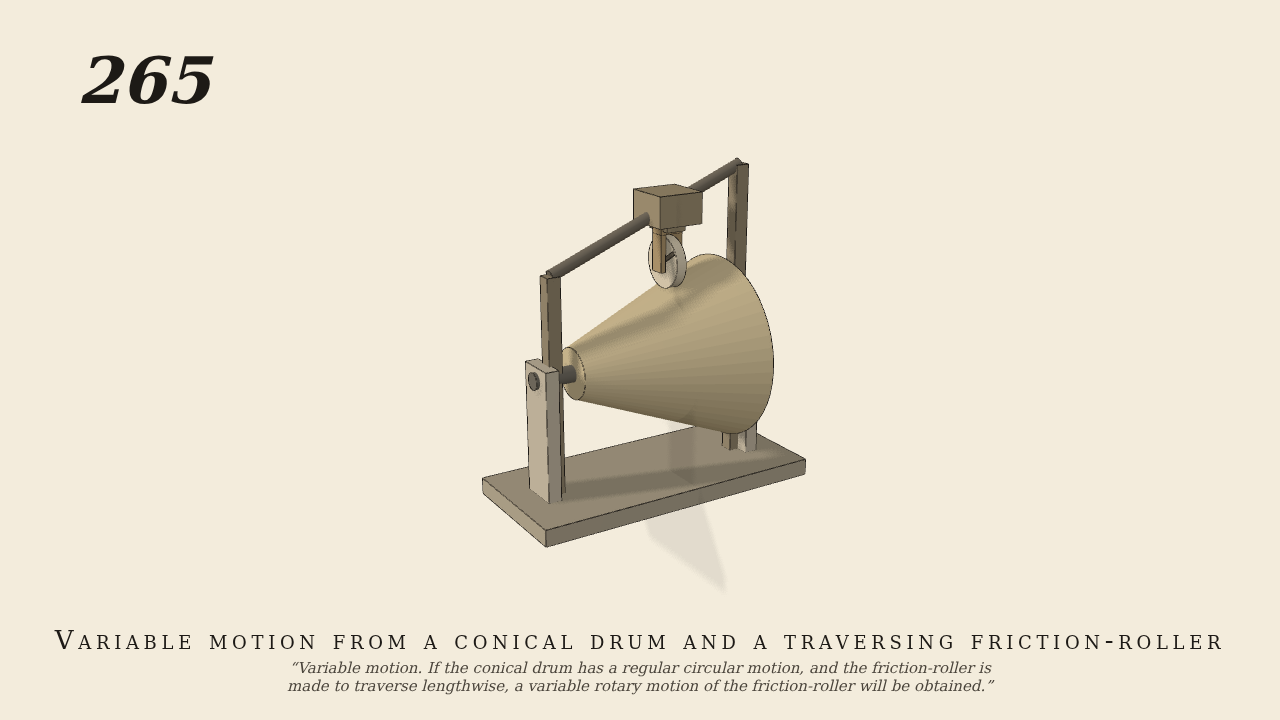
Variable motion. If the conical drum has a regular circular motion, and the friction-roller is made to traverse lengthwise, a variable rotary motion of the friction-roller will be obtained.
Only the input is driven; every other part of this model moves by physics (MuJoCo), and its ratios are measured. Run it live, change its parameters, or switch the friction off to see the output stop.
- Modelled as
- The conical drum (radius 1.5 to 5.5 cm over 10 cm, its axis level) is the one driven joint, turning steadily at 30 turns a minute. The friction-roller C (radius 1.5 cm) rides in a short vertical slide on a carriage and rests on the drum by its own weight (0.1 kg slide). The carriage (2 kg) runs on a rail laid parallel to the drum's top line, so the rail falls 21.8 degrees toward the narrow end. A dashpot on the rail (750 N s/m) lets the carriage down at a steady 0.92 cm/s, so the roller is traversed lengthwise from near the wide end toward the narrow one with no second driver. C turns by friction at the drum's radius where it touches over its own radius. Only the drum's contact on C turns it.
- Measured
- C turns at 3.20 to 3.00 of the drum over 0.5 to 1.5 s, with the carriage 0.46 to 1.37 cm down the rail (ideal 3.23 to 3.00 there). Over 7 to 8 s it turns at 1.74 to 1.53, with the carriage 6.45 to 7.37 cm down (ideal 1.75 to 1.52). Across the run it falls from 3.19 to 1.55 of the drum, staying within 0.5% of r(drum)/r(roller) at the measured position. The roller stays down on the drum to within 0.02 cm. The deepest contact is 0.01 mm.
- Notes
- Brown says only that the roller is made to traverse. Here a weighted carriage held back by a dashpot does it, so the drum is still the only driven part. The roller touches the cone at its edge toward the wide end, and that radius sets the speed.
Film (MP4) · Still (PNG) · Spec (YAML) · Model (MJCF)