Two worm-wheels of equal diameter, but one having one tooth more…
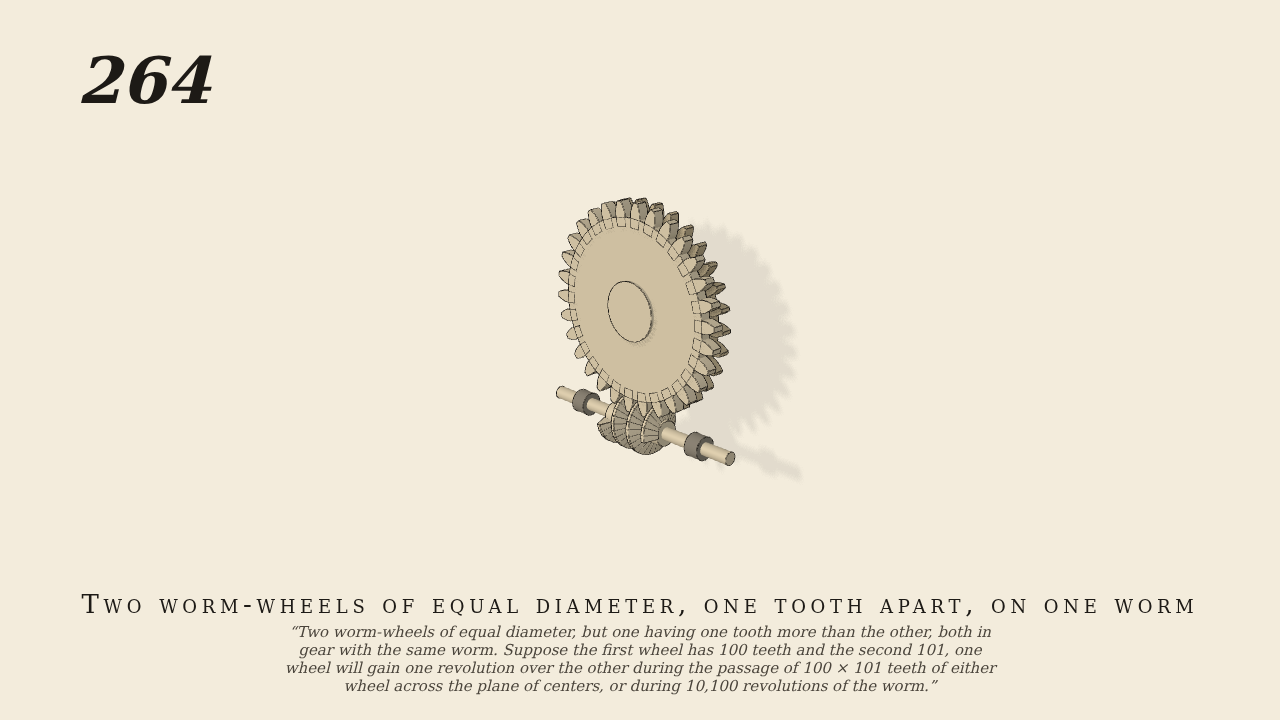
Two worm-wheels of equal diameter, but one having one tooth more than the other, both in gear with the same worm. Suppose the first wheel has 100 teeth and the second 101, one wheel will gain one revolution over the other during the passage of 100 × 101 teeth of either wheel across the plane of centers, or during 10,100 revolutions of the worm.
Only the input is driven; every other part of this model moves by physics (MuJoCo), and its ratios are measured. Run it live, change its parameters, or switch the friction off to see the output stop.
- Modelled as
- No. 31's single-thread worm (axial pitch 1.571 cm, 60 turns a minute, the one driven joint) lies along x, and over it, side by side on one fixed stud, sit two loose worm-wheels of the same pitch radius 7.5 cm. A has 30 teeth (module 0.5, matching the thread); B has 31 (module 0.484, so its teeth are a little finer), with 0.12 cm of backlash so they hunt in the same thread. Each turn of the worm moves each wheel on by one of its own teeth: A at 1/30 of the worm and B at 1/31, so A gains one turn on B in 30 x 31 = 930 turns of the worm. Brown's 100 and 101 teeth give 10,100 turns. Only the thread touches the teeth.
- Measured
- Over 1 to 9.5 s, A turns at 0.0335 of the worm (ideal 0.0333, +0.5%) and B at 0.0324 (ideal 0.0323, +0.4%). B follows A at 0.9686 (ideal 30/31 = 0.9677, r2 1.000), so A draws ahead about 4 degrees in the 10 worm turns shown. The deepest contact is 0.01 mm.
- Notes
- Brown gives 100 and 101 teeth; 30 and 31 keep the teeth visible and the drift measurable in a short run (930 worm turns to a full turn of gain instead of 10,100). The worm thread is No. 31's.
Film (MP4) · Still (PNG) · Spec (YAML) · Model (MJCF)