Another kind of stop for the same purpose
Another kind of stop for the same purpose.
Only the input is driven; every other part of this model moves by physics (MuJoCo), and its ratios are measured. Run it live, change its parameters, or switch the friction off to see the output stop.
- Modelled as
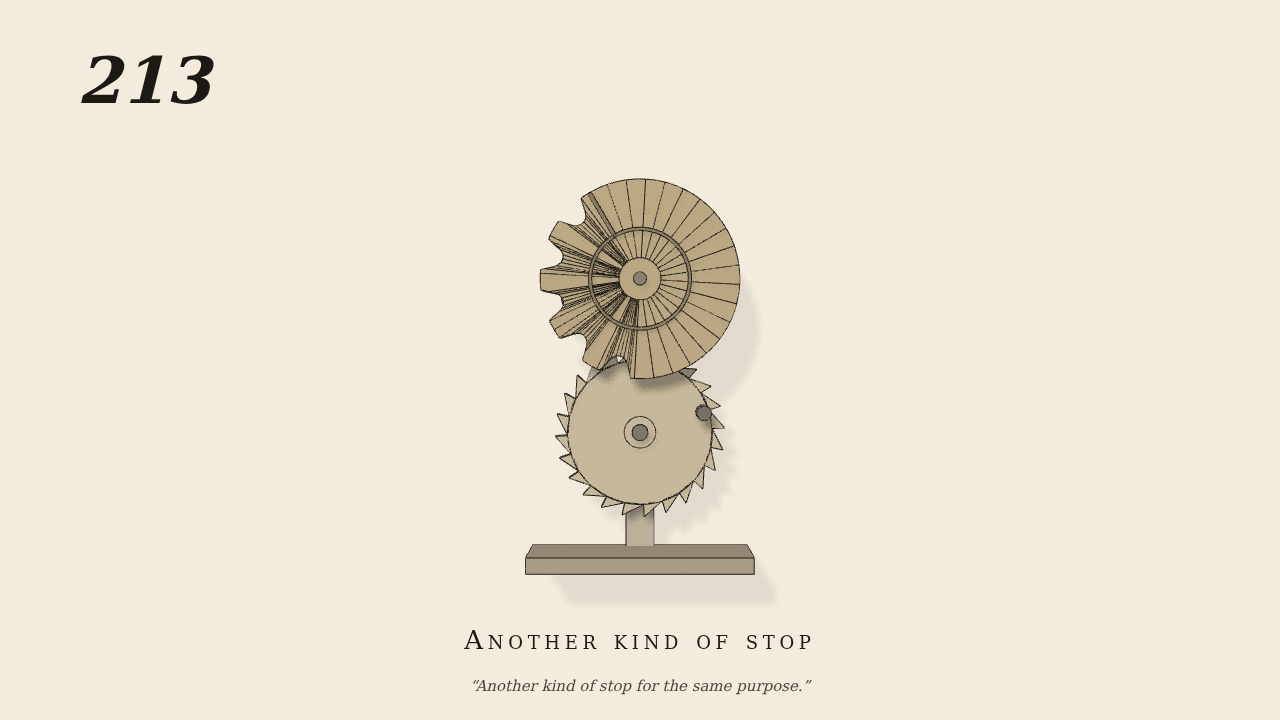
- The lower wheel A, the winding arbor with its click-wheel teeth, carries one pin at radius 4.2. The ring B above it, of radius 6.2 and 9.65 away, has a row of five notches a twelfth of a turn apart and a plain rim elsewhere. Each turn of A the pin enters a notch and turns B on by a twelfth of a turn. When B has been stepped round to either end of its row of notches, the pin next meets the plain rim, and A can turn no further that way. The notches are the pin's path in B's frame over a smooth stepping schedule of 75 degrees of A per step, with 0.05 clearance, so the pin both starts and stops B. Between steps B is held only by friction on its stud. A counterweight behind B balances it against its notches. The click-wheel teeth are drawn only. Only A is driven, to and fro (22 rad at 0.045 Hz) with a torque limit, so it stalls at each stop.
- Measured
- A runs between -21.385 and 15.102 rad, 5.8 turns between the stops; the sweep predicts -21.384 and 15.100. B runs between -1.038 and 1.603 rad: its five steps of 30 degrees, plus 2 degrees into the last stop. Max penetration 0.21 mm.
- Notes
- The click-wheel teeth and B's inner circle and slot are drawn only, and the counterweight is drawn and weighed only.
Film (MP4) · Still (PNG) · Spec (YAML) · Model (MJCF)