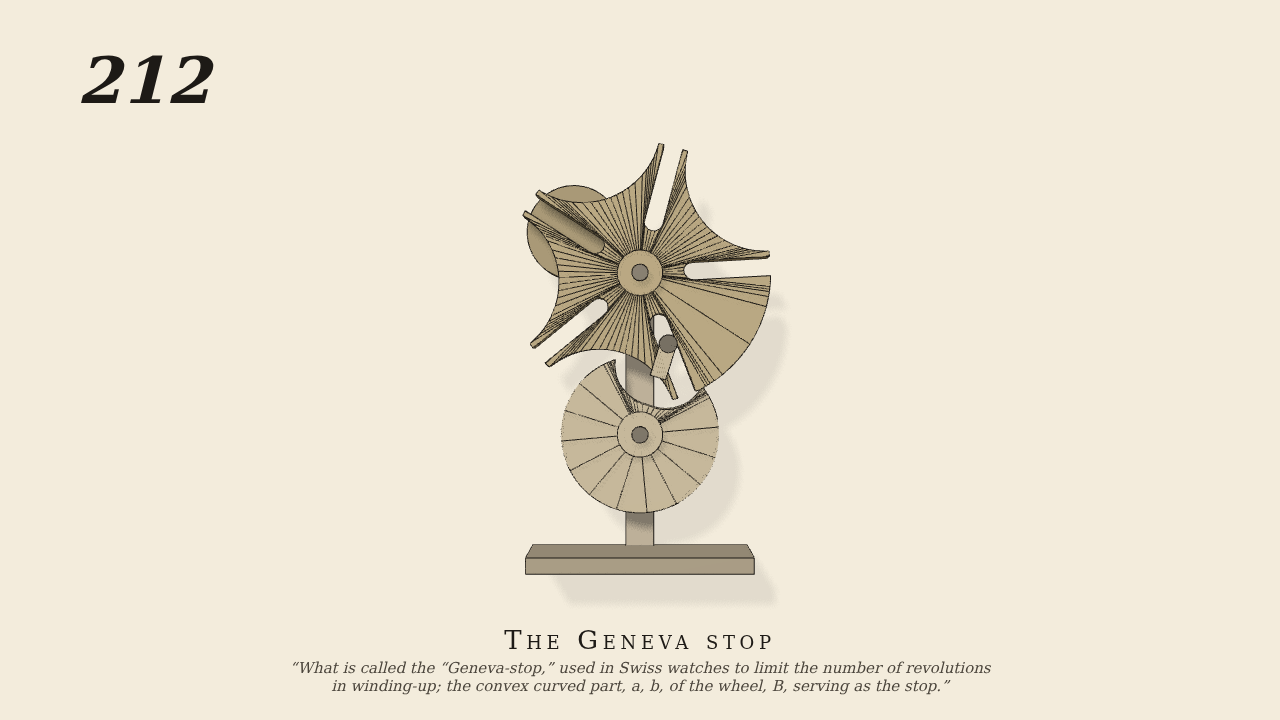
What is called the “Geneva-stop,” used in Swiss watches to limit…
What is called the “Geneva-stop,” used in Swiss watches to limit the number of revolutions in winding-up; the convex curved part, a, b, of the wheel, B, serving as the stop.
Only the input is driven; every other part of this model moves by physics (MuJoCo), and its ratios are measured. Run it live, change its parameters, or switch the friction off to see the output stop.
- Modelled as
- The finger wheel A carries one pin on a circle of radius 5.88 and a locking disc; the wheel B has five slots, 72 degrees apart, at a centre distance of 10. Each turn of A, the pin enters a slot and steps B round 72 degrees, and between steps the disc locks B by bearing on the concave flanks of its points. The disc is the plain disc less the area B sweeps through as it steps, with 0.05 clearance. One flank of B, the convex part a, b, is left uncut, so when B has stepped round to it the disc meets that full flank and A can turn no further that way. Colliding parts are built from convex pieces (A 48, B 138). A counterweight behind B balances it on its shaft, and the finger web is drawn only; the pin and disc do the work. Only A is driven, by a slow swing (22 rad at 0.06 Hz) that winds it to the stop at each end.
- Measured
- A runs between -9.12 and 15.40 rad, 3.9 turns between the stops. B runs between -2.775 and 1.518 rad: three steps of 72 degrees, plus about 15 degrees into each stop. Max penetration 0.14 mm.
- Notes
- The finger web is drawn only, and the counterweight is drawn and weighed only.
Film (MP4) · Still (PNG) · Spec (YAML) · Model (MJCF)