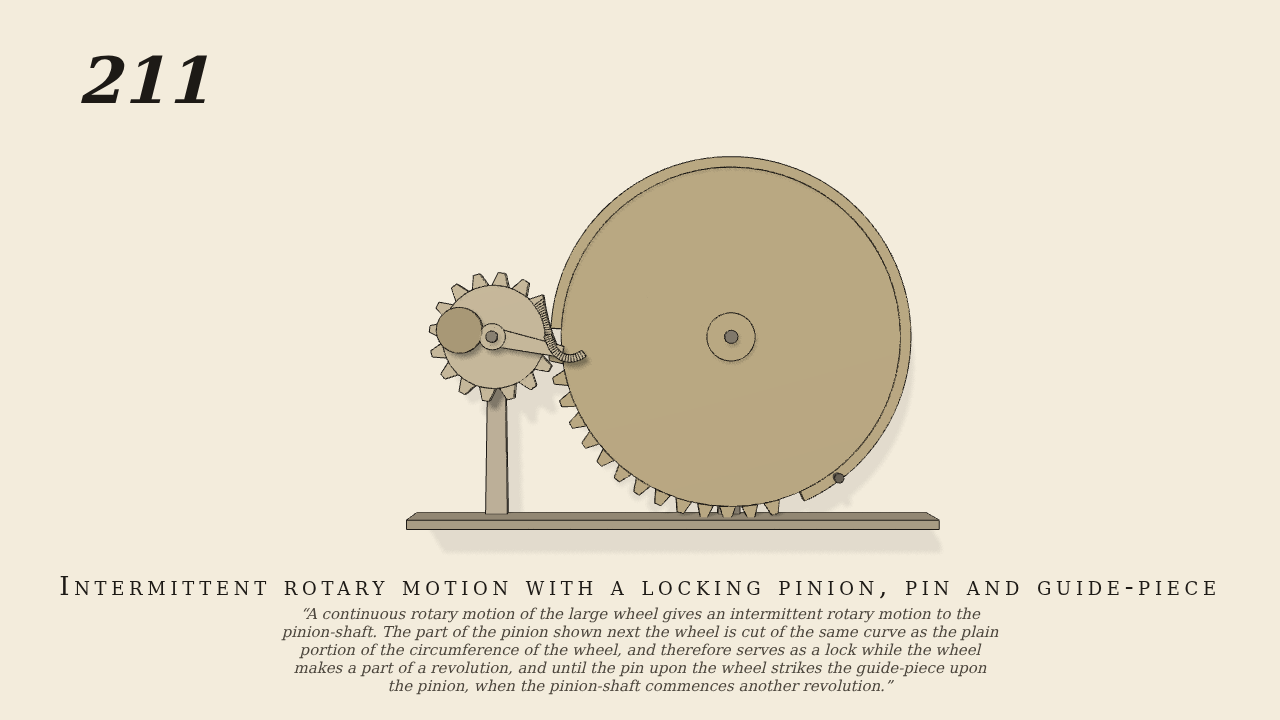
A continuous rotary motion of the large wheel gives an…
A continuous rotary motion of the large wheel gives an intermittent rotary motion to the pinion-shaft. The part of the pinion shown next the wheel is cut of the same curve as the plain portion of the circumference of the wheel, and therefore serves as a lock while the wheel makes a part of a revolution, and until the pin upon the wheel strikes the guide-piece upon the pinion, when the pinion-shaft commences another revolution.
Only the input is driven; every other part of this model moves by physics (MuJoCo), and its ratios are measured. Run it live, change its parameters, or switch the friction off to see the output stop.
- Modelled as
- The pinion has 16 tooth places at module 0.8, with No. 34's straight-flanked teeth, and carries teeth on 13 of them. The other three, and the spaces between them, are filled and cut to an arc of radius 19.51 about the wheel's centre. That is a hair larger than the wheel's plain rim (19.45), so while the rim runs past, the pinion cannot turn either way. The large wheel has 48 tooth places, with teeth on a segment of 14 and the plain rim elsewhere; the rim is cut back to the root where the pinion must turn. A pin on the wheel's face, in front, meets the guide-piece on the pinion's face as the segment comes round. The guide's curve is the envelope of the pin for a pinion speeding up smoothly from rest to the gearing's speed over 12 degrees of the wheel, after which the segment's first tooth takes over. The segment then turns the pinion on round to its lock: one turn for each turn of the wheel. The teeth and rim kept are those that never foul the pinion in a sweep of that schedule. A counterweight balances the pinion on its shaft. Only the wheel is driven (10 rpm).
- Measured
- Over 0.1-12.1 s the pinion turns -1.0009 times the wheel (one turn per turn). In 24 slices its speed over the wheel's runs from 0 (locked) to -3.001 (geared; 48/16 = 3). The pin strikes the guide at each start, and the pinion stops at its lock within about 1 degree. Max penetration 0.03 mm.
- Notes
- The guide-piece and pin work in a plane in front of the teeth, and the counterweight is drawn and weighed only.
Film (MP4) · Still (PNG) · Spec (YAML) · Model (MJCF)