By turning the shaft carrying the curved slotted arm, a…
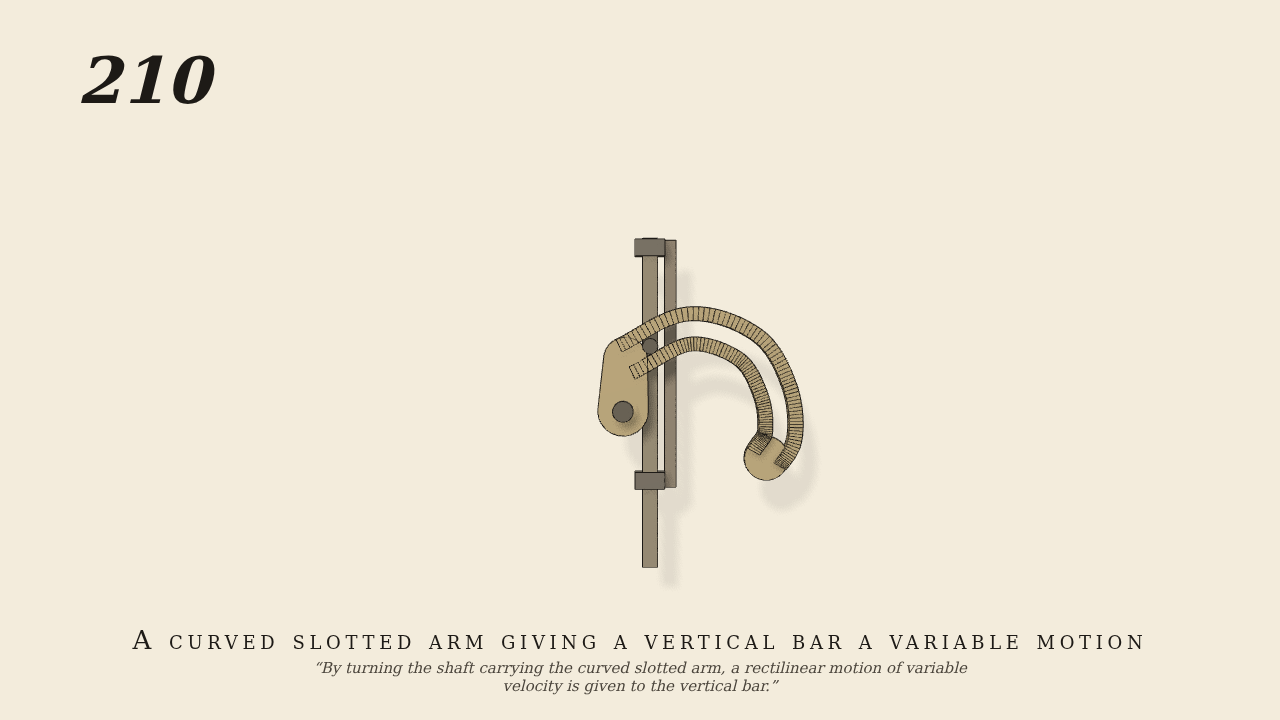
By turning the shaft carrying the curved slotted arm, a rectilinear motion of variable velocity is given to the vertical bar.
Only the input is driven; every other part of this model moves by physics (MuJoCo), and its ratios are measured. Run it live, change its parameters, or switch the friction off to see the output stop.
- Modelled as
- The shaft carries an arm with a curved slot, drawn as a smooth curve through the plate's points: from low on the left, up and over the top to the right. A vertical bar slides in two guides, its line 1.6 to the right of the shaft and behind the arm, and a pin on the bar (radius 0.45, clearance 0.04) works in the slot. Only the shaft is driven, turned to and fro by hand (+-0.72 rad at 0.3 Hz) through the part of a turn over which the slot crosses the bar's line. A full turn would carry the slot clear of the bar. As the arm turns, the crossing point runs along the slot and the slot's slant to the bar changes, so the bar rises and falls 5.34 at a rate from 1.02 to 5.75 per radian of the shaft (kinematics). Gravity is on, and the bar's weight rests the pin on the slot's lower side.
- Measured
- Over 0.2-9.7 s the bar travels -3.58 to +1.80 about its start (kinematics -3.49 to +1.84, less the clearance), steadily from stroke to stroke. Its speed over the shaft's, in 16 slices, runs from 0.013 to 0.052 m/rad (kinematics 0.010 to 0.057). Max penetration 0.01 mm.
- Notes
- The bar's stops, just beyond the travel, are never reached in work: they only hold it when the pin is out. The arm rocks about a position turned 0.7 rad clockwise from the drawing, so that the drawn position is one end of the stroke.
Film (MP4) · Still (PNG) · Spec (YAML) · Model (MJCF)