A mode of obtaining motion from rolling contact
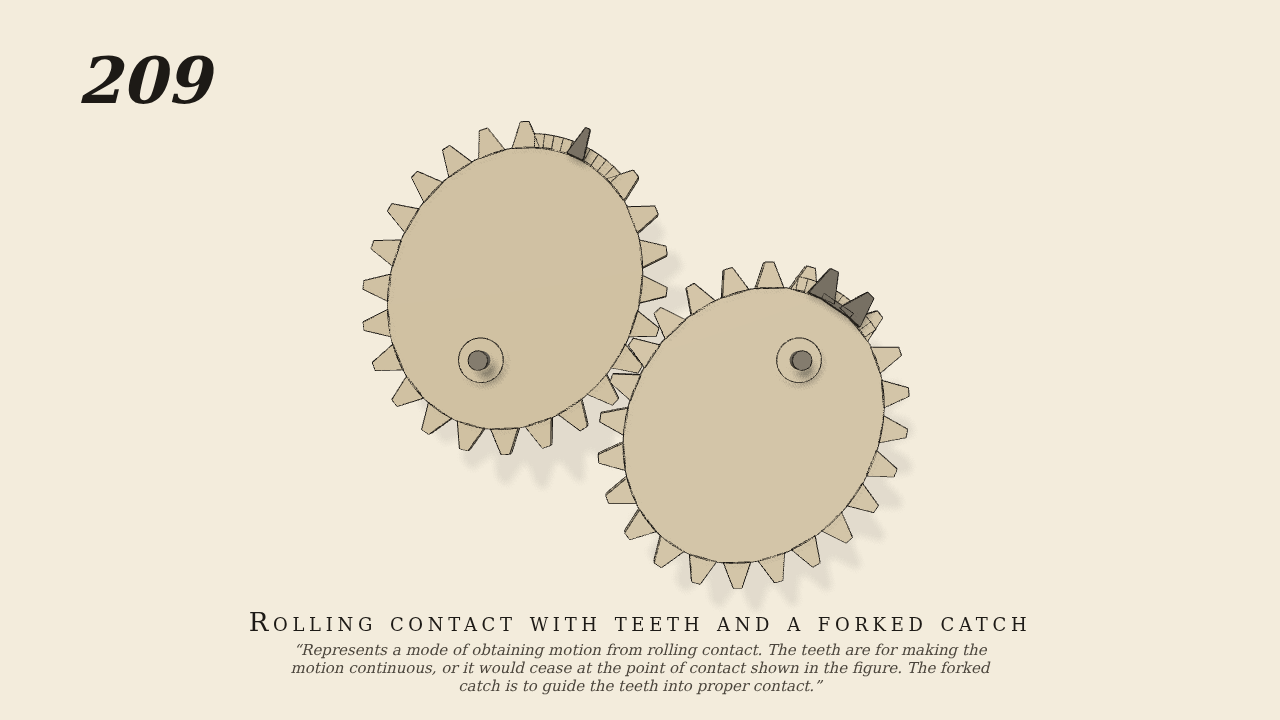
Represents a mode of obtaining motion from rolling contact. The teeth are for making the motion continuous, or it would cease at the point of contact shown in the figure. The forked catch is to guide the teeth into proper contact.
Only the input is driven; every other part of this model moves by physics (MuJoCo), and its ratios are measured. Run it live, change its parameters, or switch the friction off to see the output stop.
- Modelled as
- This uses No. 33's pair of equal elliptical wheels: semi-axes 10 and 8.66, each on a shaft through one focus, with the shafts 20 apart, so the pitch ellipses roll on each other. Each wheel carries 24 straight-flanked teeth at equal arc pitch, except over the part where, as the plate draws them, they roll plain: the left wheel's far vertex on the right wheel's near vertex. Two of the left wheel's teeth and one of the right's are left out there, and the rims run out to the pitch curves. In a plane in front of the teeth, the left wheel carries a pointed horn in the middle of its plain part and the right wheel a forked catch of two prongs. The horn enters the fork as the plain parts come round and carries the drive across them until the teeth take it up again. Only the left wheel is driven (20 rpm).
- Measured
- Over 1-7 s the right wheel turns -1.0101 times the driver on average, and from -3.149 to -0.293 within each turn (the ellipses give -3 to -1/3). Sampled over 1-7 s, the catch alone carries the drive 4% of the time. Max penetration 0.07 mm.
- Notes
- The plain rims are drawn but do not press on each other: the shafts are fixed, so the plain parts touch without load, and the horn and fork carry the drive there.
Film (MP4) · Still (PNG) · Spec (YAML) · Model (MJCF)