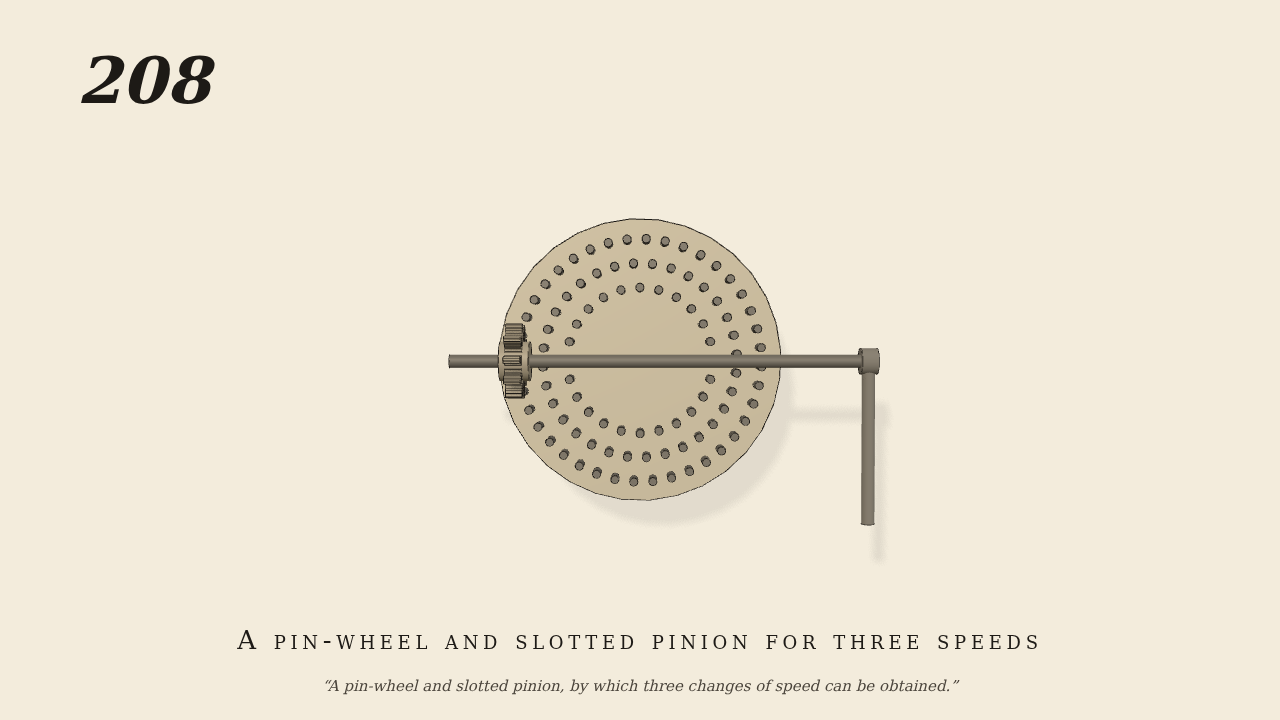
A pin-wheel and slotted pinion, by which three changes of speed…
A pin-wheel and slotted pinion, by which three changes of speed can be obtained. There are three circles of pins of equal distance on the face of the pin-wheel, and by shifting the slotted pinion along its shaft, to bring it in contact with one or the other of the circles of pins, a continuous rotary motion of the wheel is made to produce three changes of speed of the pinion, or vice versa.
Only the input is driven; every other part of this model moves by physics (MuJoCo), and its ratios are measured. Run it live, change its parameters, or switch the friction off to see the output stop.
- Modelled as
- Three circles of round pins stand from the pin-wheel's face, all at one pitch of 1.2: 24 on radius 4.58, 32 on 6.11 and 40 on 7.64. The wheel is the only driven joint (10 rpm). In front of the face a shaft runs across the wheel along a radius and carries a slotted pinion with 10 slots (pitch radius 1.91). The pinion's teeth are the shapes that the pins of all three circles leave free when wheel and pinion turn together, less 0.06 clearance, each built as 7 stacked slabs. Shifting the pinion along its shaft to another circle changes its speed.
- Measured
- With the pinion on the outer circle, as in the plate, it turns -3.9997 times the wheel (-40/10) over 1-7 s, with 0.01% slip. Built by the generator at the other circles, the same pinion gives -3.2011 (middle, -32/10) and -2.4000 (inner, -24/10). Max penetration 0.03 mm.
- Notes
- The file shows the plate's setting; the generator's VAR=middle or VAR=inner places the pinion at the other circles. A body_pos variant does not move a part's pieces, so the settings are not offered as variants. The pinion carries a small bearing friction.
Film (MP4) · Still (PNG) · Spec (YAML) · Model (MJCF)