Other modifications of the stop, the operations of which will be…
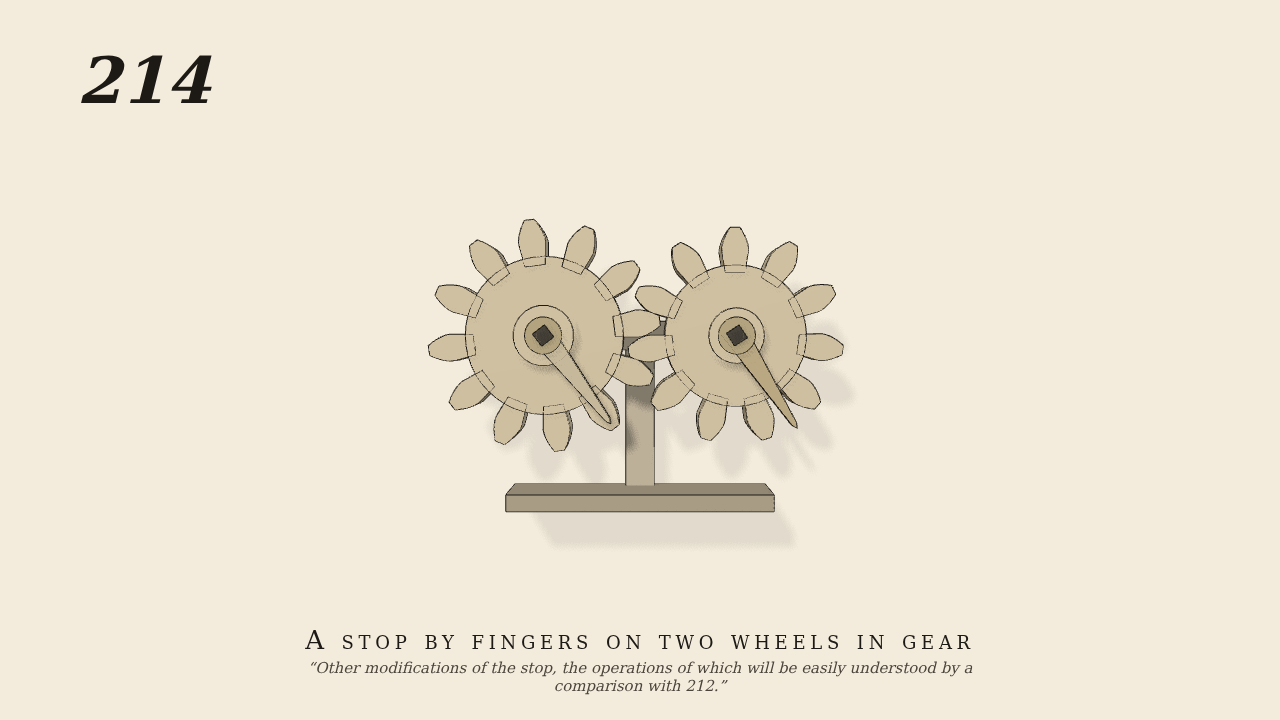
214 and 215. Other modifications of the stop, the operations of which will be easily understood by a comparison with 212.
Only the input is driven; every other part of this model moves by physics (MuJoCo), and its ratios are measured. Run it live, change its parameters, or switch the friction off to see the output stop.
- Modelled as
- Two spur wheels of 12 and 11 teeth (module 1, centres 11.5 apart) are in gear, and each carries a tapered finger, 6.6 long, on its square arbor in a plane in front of the teeth. The fingers reach past the middle of the line of centres, so they meet only if both point along it at the same time. The wheels turn at 12:11, so that happens once in 11 turns of the 12-wheel. The fingers then stop the wheels, from one side going forward and from the other going back. Counterweights behind the wheels balance the fingers. Only the 12-wheel's arbor is driven, to and fro (40 rad at 0.035 Hz) with a torque limit of 3 N m, so it stalls at each stop.
- Measured
- The 11-wheel turns -1.0909 times the 12-wheel (12/11), with no slip, over 0.5-3.5 s. The arbor runs between -34.101 and 34.102 rad, 10.85 turns between the stops; the sweep predicts plus or minus 34.094. Max penetration 0.09 mm.
- Notes
- The counterweights are drawn and weighed only. No. 215, the other modification on the same plate, is a separate movement.
Film (MP4) · Still (PNG) · Spec (YAML) · Model (MJCF)