Other modifications of the stop, the operations of which will be…
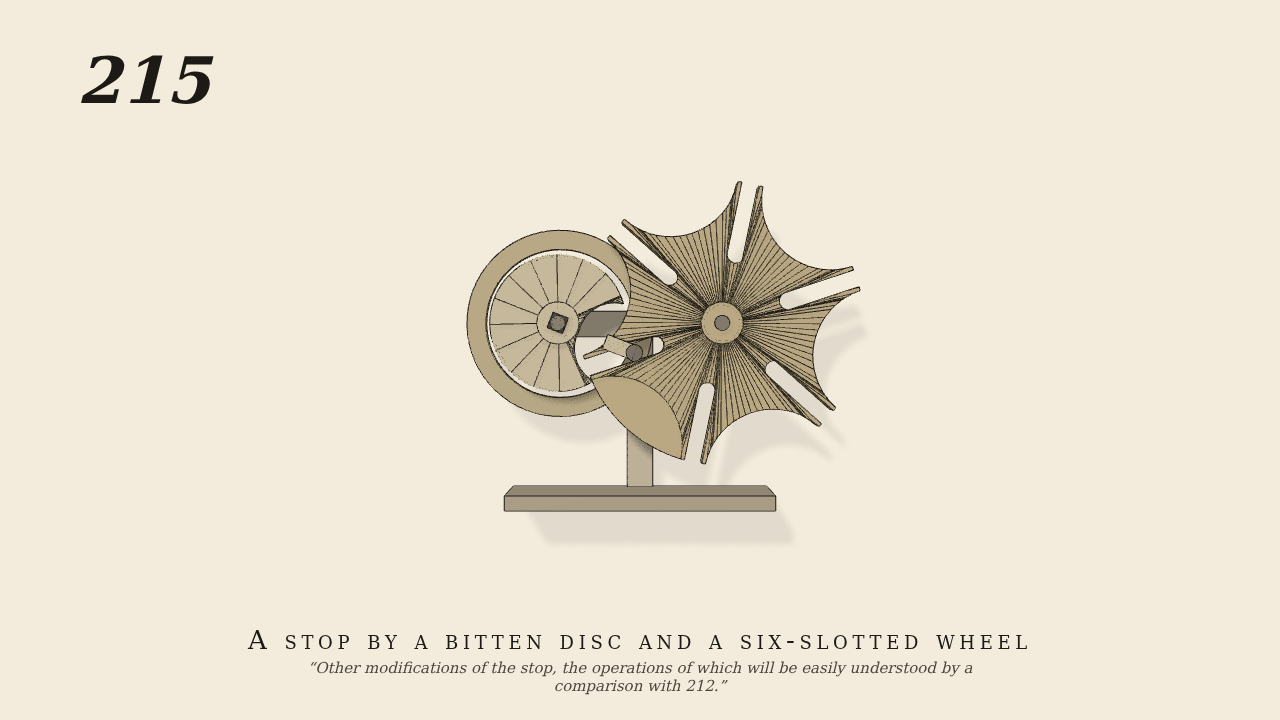
214 and 215. Other modifications of the stop, the operations of which will be easily understood by a comparison with 212.
Only the input is driven; every other part of this model moves by physics (MuJoCo), and its ratios are measured. Run it live, change its parameters, or switch the friction off to see the output stop.
- Modelled as
- This is No. 212 with six slots and the wheels side by side. A, on the left, on the square arbor, is a disc of radius 4.6 with a bite cut in its edge and a pin (pin circle 5.5, radius 0.55) at the bottom of the bite; an outer ring is drawn behind it. B, on the right, 11 away, has six slots, and between them flanks cut to A's disc with 0.05 clearance, so it is locked except while the pin is in a slot, which turns it a sixth of a turn. One flank is left uncut. When the pin brings it round, it meets A's disc and A can go no further. The bite is A's disc less the room B sweeps through in its steps (by sweep). The uncut flank's extra stuff is a thin plate on B's front face, where it meets A's disc, and a small counterweight behind B balances it. Only A is driven, to and fro (22 rad at 0.06 Hz) with a torque limit of 1.5 N m, so it stalls at each stop.
- Measured
- A runs between -15.336 and 15.338 rad, 4.9 turns between the stops. B runs between -2.299 and 2.300 rad: four steps of 60 degrees, plus about 12 degrees into each stop. Max penetration 0.10 mm.
- Notes
- The outer ring of A and the counterweight are drawn and weighed only; both are clear of the working parts. No. 214, on the same plate, is a separate movement.
Film (MP4) · Still (PNG) · Spec (YAML) · Model (MJCF)