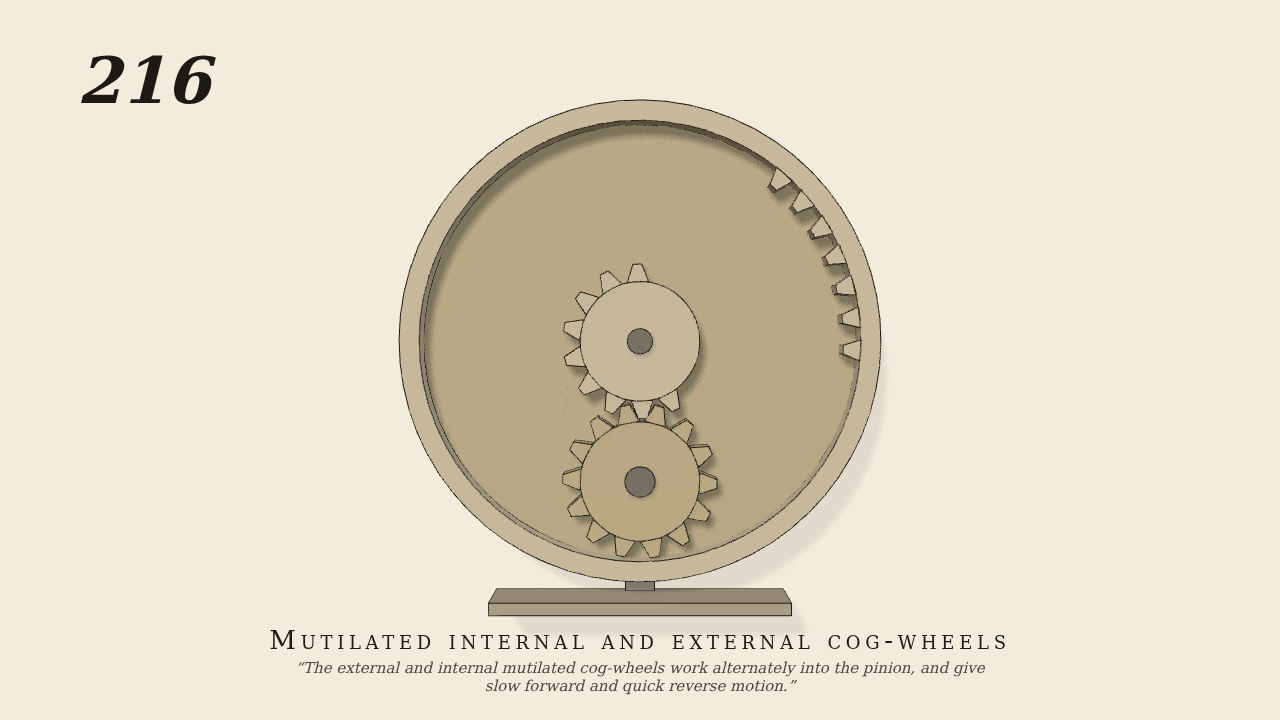
The external and internal mutilated cog-wheels work alternately…
The external and internal mutilated cog-wheels work alternately into the pinion, and give slow forward and quick reverse motion.
Only the input is driven; every other part of this model moves by physics (MuJoCo), and its ratios are measured. Run it live, change its parameters, or switch the friction off to see the output stop.
- Modelled as
- One wheel carries an internal cog-ring of 42 tooth places and, on the same arbor, an external cog-wheel of 14 places (module 0.8); a 14-tooth pinion stands 11.2 below the arbor, between the two, so it can gear with either. The ring keeps 7 teeth and the inner wheel 9, on opposite sides, so they work into the pinion by turns: the inner wheel turns it slowly the opposite way (1:1), the ring quickly the same way (3:1). The ring's longer arc of contact lets its 7 teeth turn the pinion as far as the inner wheel's 9, so the pinion comes back each turn of the wheel. Straight-flanked teeth with the tooth phases of full wheels in mesh; between the arcs the pinion stands by friction. A counterweight behind balances the wheel. Only the wheel is driven (10 rpm).
- Measured
- Pinion/wheel 3.001 on the ring (twice) and -1.000 on the inner wheel; the pinion swings 0..4.29 rad (about 245 degrees) each turn and returns; penetration 0.07 mm.
- Notes
- Teeth chosen by count around opposite arc centres (a sweep that dropped fouling teeth left short travel and jams at the handover); about 45 min of tuning, kept because the design then worked.
Film (MP4) · Still (PNG) · Spec (YAML) · Model (MJCF)