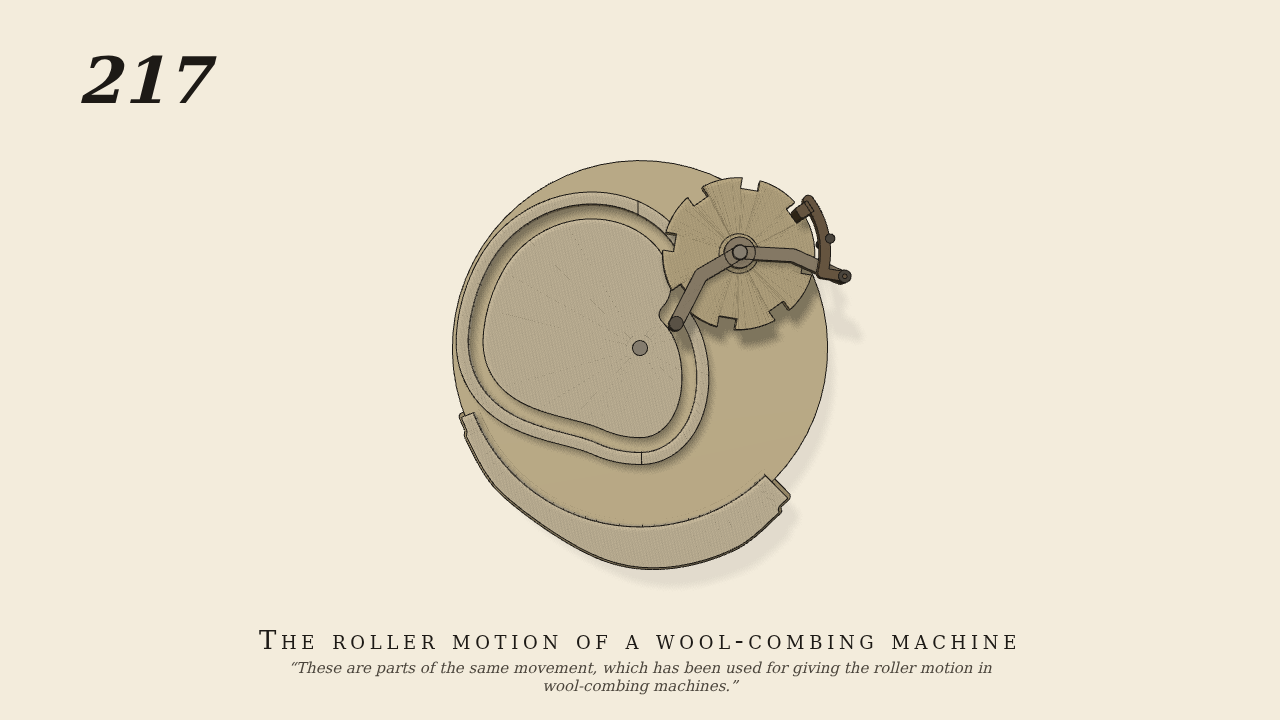
These are parts of the same movement, which has been used for…
217 and 218. These are parts of the same movement, which has been used for giving the roller motion in wool-combing machines. The roller to which wheel, F (218), is secured is required to make one third a revolution backward, then two thirds of a revolution forward, when it must stop until another length of combed fiber is ready for delivery. This is accomplished by the grooved heart-cam, C, D, B, e (217), the stud, A, working in the said groove; from C to D it moves the roller backward, and from D to e it moves it forward, the motion being transmitted through the catch, G, to the notch-wheel, F, on the roller-shaft, H. When the stud, A, arrives at the point, e, in the cam, a projection at the back of the wheel which carries the cam strikes the projecting piece on the catch, G, and raises it out of the notch in the wheel, F, so that, while the stud is traveling in the cam from e to C, the catch is passing over the plain surface between the two notches in the wheel, F, without imparting any motion; but when stud, A, arrives at the part, C, the catch has dropped in another notch, and is again ready to move wheel, F, and roller as required.
Only the input is driven; every other part of this model moves by physics (MuJoCo), and its ratios are measured. Run it live, change its parameters, or switch the friction off to see the output stop.
- Modelled as
- The wheel that carries the grooved heart-cam (No. 217) turns on a shaft 6.5 left of and 6.2 below the roller shaft H. The lever of No. 218 swings on H, and its stud A, 6.2 below H, works in the groove (radius 0.45, clearance 0.05). The groove is the path of the stud in the frame of the cam wheel, so each turn the lever swings back 45 degrees (C to D), forward 90 degrees (D to e), stands, comes back 45 degrees (e to C), and stands again. The catch G is pinned to the upper arm of the lever and sprung down. Its square tooth drops into one of the eight notches of the wheel F on H, so F goes back and forward with the lever. Just after e, a projection on the back of the cam wheel meets a pin on the catch and lifts it out. On the way back from e to C the catch passes over the plain rim of F, and at C it drops into the next notch. So F goes back one notch, forward two, and stands: one notch on each turn. The projection is the path of the pin in the frame of the cam wheel. Only the cam wheel is driven (6 rpm, clockwise as the arrow on the plate).
- Measured
- F turns 1.0000 times the lever on the back and the forward strokes. While the catch is lifted, F stands at 0.735, 1.521 and 2.306 rad after the first three turns: one notch (0.785) a turn, less 0.05 of backlash. The catch lifts 0.149 rad. Max penetration 0.03 mm.
- Notes
- Nos. 217 and 218 are parts of the same movement, and this model shows both: the heart-cam (217) and the lever, catch and notch-wheel (218). Seamless faces are drawn over the convex pieces of the cam and of F. The text gives a third of a turn back and two thirds forward for the roller. Here the lever strokes are one notch back and two forward, as the plate shows eight notches.
Film (MP4) · Still (PNG) · Spec (YAML) · Model (MJCF)