Variable circular motion by crown-wheel and pinion
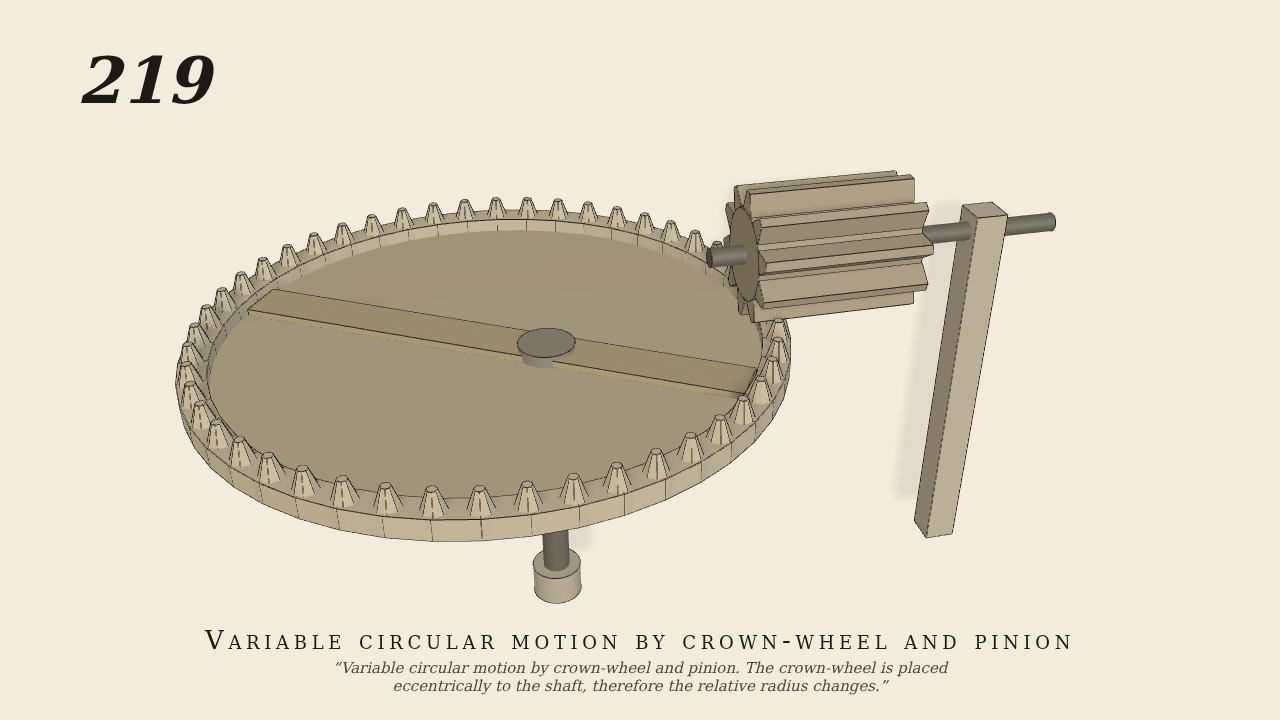
Variable circular motion by crown-wheel and pinion. The crown-wheel is placed eccentrically to the shaft, therefore the relative radius changes.
Only the input is driven; every other part of this model moves by physics (MuJoCo), and its ratios are measured. Run it live, change its parameters, or switch the friction off to see the output stop.
- Modelled as
- A crown-wheel of 48 teeth (module 0.5, pitch radius 12) turns on an upright shaft, but its centre is 2.5 off the shaft, so its pitch circle runs from 9.5 to 14.5 out along the line of the pinion. The pinion has 10 teeth (pitch radius 2.5) on a level shaft over that line, with long teeth (8.55 to 15.45 out) so the crown teeth stay in mesh wherever the circle crosses. The crown's teeth are tapered pins, so they mesh the same way at any slant to the pinion; the pinion's teeth are straight-flanked bars. Only the crown-wheel is driven (10 rpm).
- Measured
- Over one turn of the wheel the pinion turns 4.7995 times as much (48/10 = 4.8). The speed ratio changes with the distance of the meshing point from the shaft: slice means 3.716 to 5.877 (3.8 to 5.8 from the radii). Max penetration 0.03 mm.
- Notes
- The plate does not give the numbers of teeth or the eccentricity; these are chosen. The crown teeth are drawn as pins, not bars, as the line of the pinion crosses them at up to 12 degrees.
Film (MP4) · Still (PNG) · Spec (YAML) · Model (MJCF)