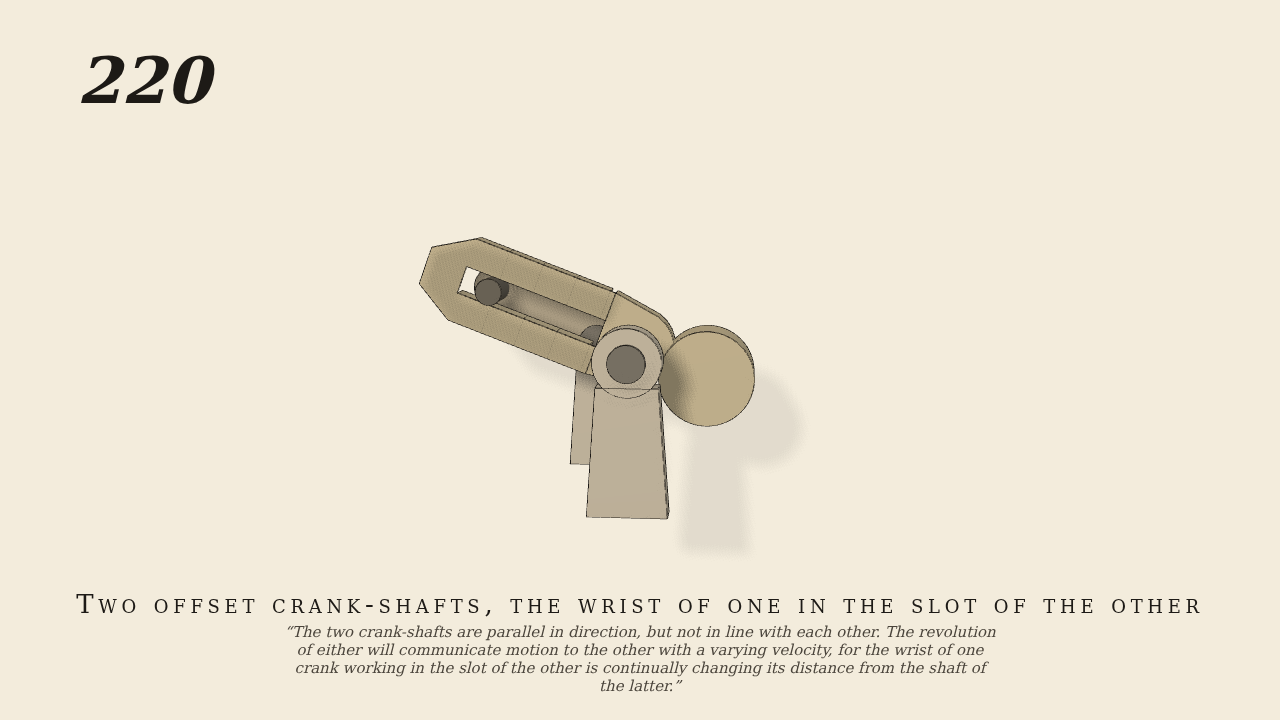
The two crank-shafts are parallel in direction, but not in line…
The two crank-shafts are parallel in direction, but not in line with each other. The revolution of either will communicate motion to the other with a varying velocity, for the wrist of one crank working in the slot of the other is continually changing its distance from the shaft of the latter.
Only the input is driven; every other part of this model moves by physics (MuJoCo), and its ratios are measured. Run it live, change its parameters, or switch the friction off to see the output stop.
- Modelled as
- Two level shafts are parallel but not in line: the slotted crank's shaft is 1.5 to the right of the driving crank's. The driving crank's wrist (radius 0.45), 4 out, works in the slot of the other crank (clearance 0.04), so its distance from the slotted crank's shaft runs from 2.5 to 5.5 through the turn. The slotted crank has a counterweight, so it balances on its shaft (gravity is on). Only the driving crank is driven (10 rpm).
- Measured
- The slotted crank turns once for each turn of the driver (ratio 0.9997). Its speed runs from 0.727 to 1.577 times the driver's in 48 slices (4/5.5 = 0.727 to 4/2.5 = 1.6 from the geometry). Max penetration 0.02 mm.
- Notes
- The plate gives no sizes; the crank radius and the offset are chosen. The counterweight is added so that the slotted crank does not swing under its own weight when the wrist is out of the slot.
Film (MP4) · Still (PNG) · Spec (YAML) · Model (MJCF)