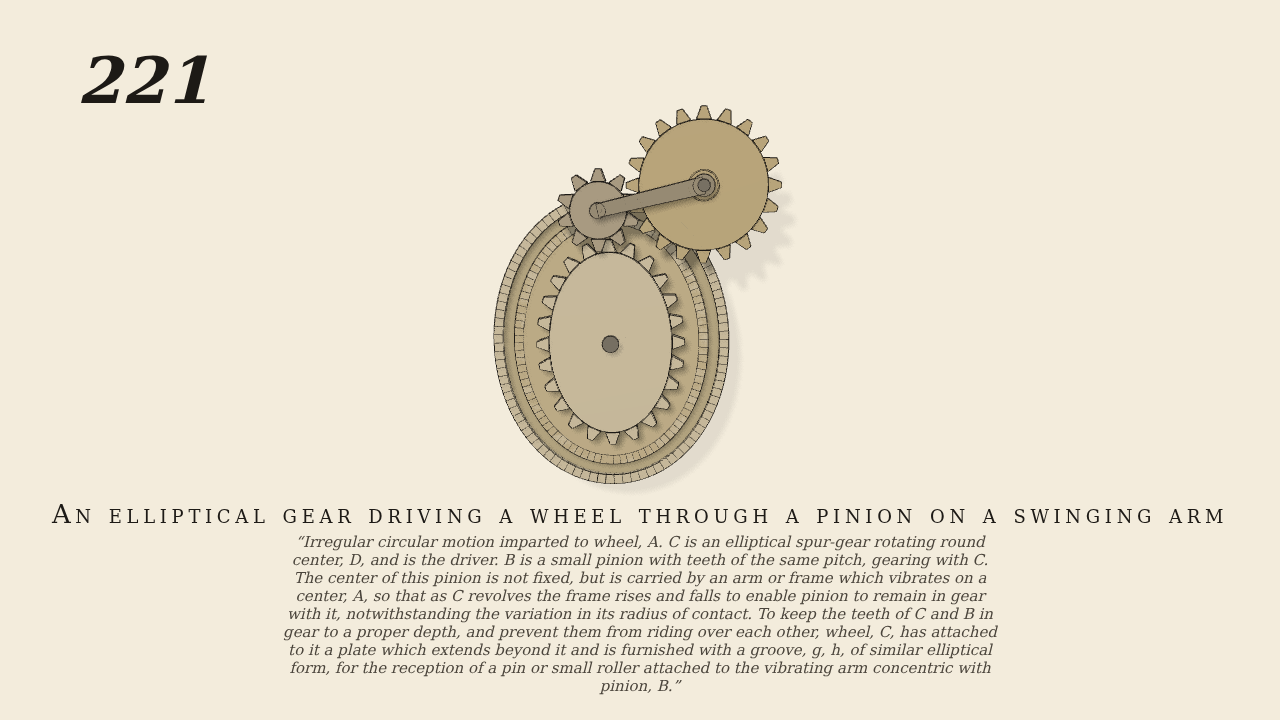
Irregular circular motion imparted to wheel, A. C is an elliptical…
Irregular circular motion imparted to wheel, A. C is an elliptical spur-gear rotating round center, D, and is the driver. B is a small pinion with teeth of the same pitch, gearing with C. The center of this pinion is not fixed, but is carried by an arm or frame which vibrates on a center, A, so that as C revolves the frame rises and falls to enable pinion to remain in gear with it, notwithstanding the variation in its radius of contact. To keep the teeth of C and B in gear to a proper depth, and prevent them from riding over each other, wheel, C, has attached to it a plate which extends beyond it and is furnished with a groove, g, h, of similar elliptical form, for the reception of a pin or small roller attached to the vibrating arm concentric with pinion, B.
Only the input is driven; every other part of this model moves by physics (MuJoCo), and its ratios are measured. Run it live, change its parameters, or switch the friction off to see the output stop.
- Modelled as
- C is an elliptical spur-gear of 24 teeth (module 0.6; pitch curve an ellipse 16.81 by 11.77, so its perimeter is 24 pitches) turning about its centre D. The pinion B (10 teeth) gears with C and with the wheel A (20 teeth), and turns on an arm that swings on A's centre. A pin on the arm, concentric with B (radius 0.45, clearance 0.04), works in the groove g h of the plate behind C. The groove is C's pitch curve offset by B's pitch radius, so B stays at the right depth while the arm rises and falls 17 degrees. The teeth are straight-flanked and set along the normals of the pitch curve. Gravity is on. Only C is driven (6 rpm).
- Measured
- Over one turn of C, A turns 1.2016 times as much (24/20 = 1.2). Its speed runs from 0.460 to 2.009 times C's in 48 slices (0.522 to 2.069 from the kinematics of B rolling on C and on A, the arm's swing included). Max penetration 0.05 mm.
- Notes
- The plate gives no sizes or numbers of teeth; these are chosen. A's speed changes with both the radius of contact on C and the swing of the arm, so it varies more than the ratio of C's semi-axes alone.
Film (MP4) · Still (PNG) · Spec (YAML) · Model (MJCF)