If for the eccentric wheel described in the last figure an…
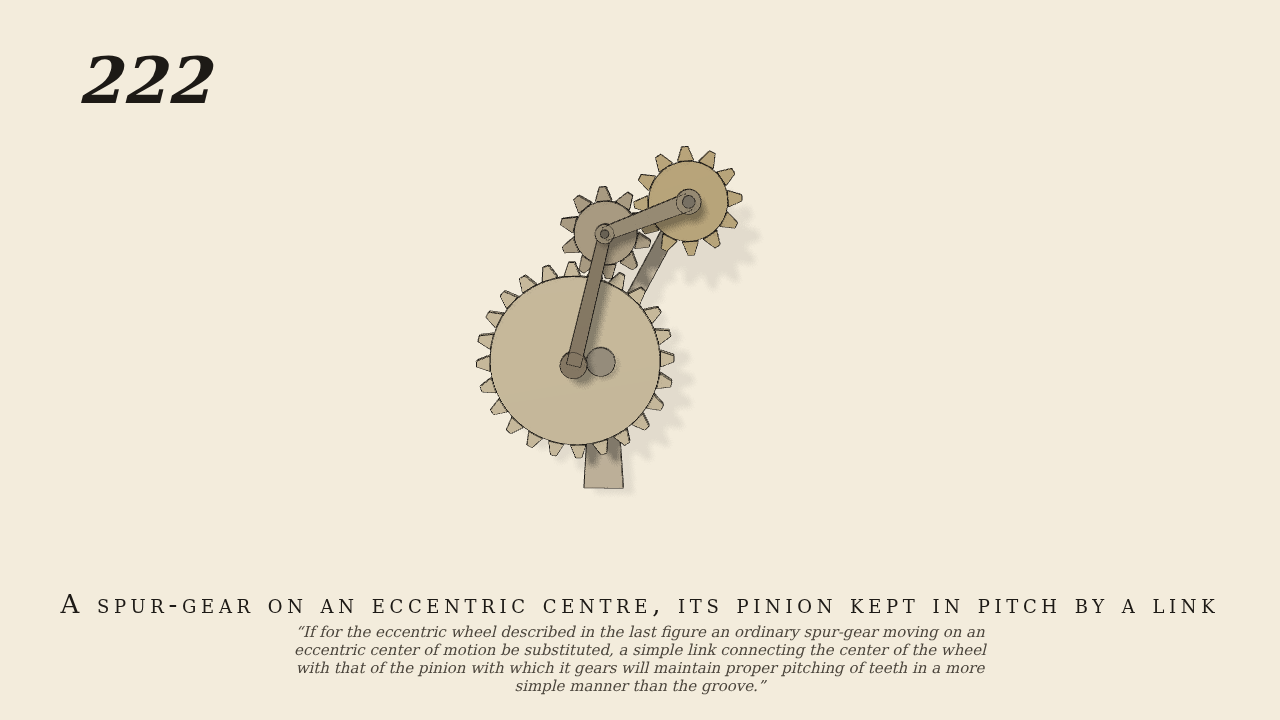
If for the eccentric wheel described in the last figure an ordinary spur-gear moving on an eccentric center of motion be substituted, a simple link connecting the center of the wheel with that of the pinion with which it gears will maintain proper pitching of teeth in a more simple manner than the groove.
Only the input is driven; every other part of this model moves by physics (MuJoCo), and its ratios are measured. Run it live, change its parameters, or switch the friction off to see the output stop.
- Modelled as
- As in No. 221, but C is an ordinary spur-gear of 24 teeth (module 0.6, pitch radius 7.2) turning on a centre D 2.0 from its own centre. The pinion B (10 teeth) gears with C and with the wheel A (12 teeth), and turns on an arm (6.6) that swings on A's centre. Instead of the groove, a link (10.2) turns on a stud at C's centre and is pinned to the arm at B's centre. So B stays at C's pitching while the arm swings 38.7 degrees. Straight-flanked teeth. Gravity is on. Only C is driven (6 rpm).
- Measured
- Over one turn of C, A turns 1.9998 times as much (24/12 = 2). Its speed runs from 0.939 to 3.199 times C's in 48 slices (0.954 to 2.945 from the kinematics of B rolling on C and on A, the arm's swing included). Max penetration 0.03 mm.
- Notes
- The plate gives no sizes or numbers of teeth; these are chosen. A has 12 teeth so that D, C's centre, the link and the arm make a crank and rocker (C turns fully while the arm only swings). The fastest slices run up to 9% above the kinematics, from the play in the teeth.
Film (MP4) · Still (PNG) · Spec (YAML) · Model (MJCF)