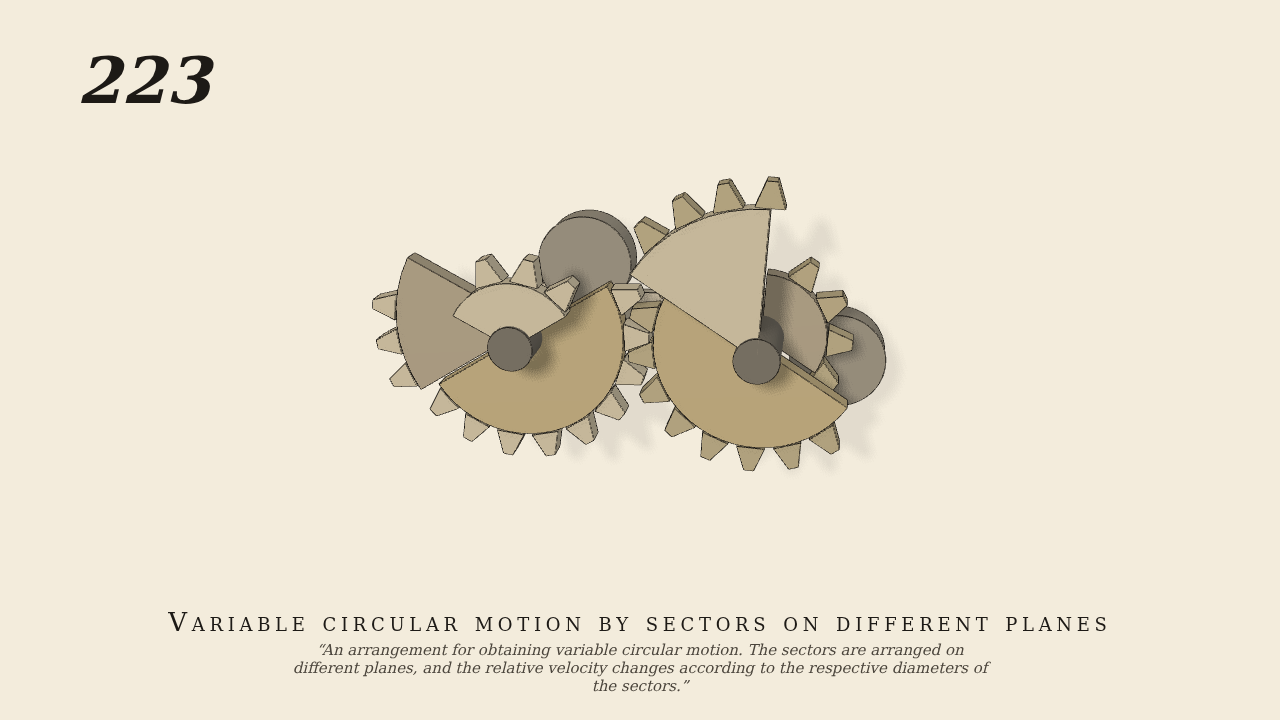
An arrangement for obtaining variable circular motion
An arrangement for obtaining variable circular motion. The sectors are arranged on different planes, and the relative velocity changes according to the respective diameters of the sectors.
Only the input is driven; every other part of this model moves by physics (MuJoCo), and its ratios are measured. Run it live, change its parameters, or switch the friction off to see the output stop.
- Modelled as
- Two parallel shafts 10.8 apart each carry three toothed sectors (module 0.6), one in each of three planes. The pairs are cut from wheels of 12 and 24, 18 and 18, and 24 and 12 teeth, with 4, 9 and 4 teeth. So the driver's sectors fill its circle (120, 180 and 60 degrees), and the follower's fill its circle too (60, 180 and 120 degrees). The pairs come into gear in turn, and the follower turns 0.5, 1 and 2 times as fast as the driver. Where the slow pair follows the fast one, the fast driving sector leaves out its last tooth and the slow one its first; otherwise the follower's fast teeth would have to pass the slow driver's first tooth inside the mesh. So the follower (0.6 kg) runs on free for a moment and the slow pair catches it. Each shaft has a counterweight behind its sectors, so it balances (gravity is on). Only the driver is driven (10 rpm).
- Measured
- The follower turns once a turn of the driver (ratio 1.0012). In 36 slices its speed runs from 0.363 to 2.035 times the driver's: 0.5, 1 and 2 in turn, with the slow slices dipping lower after the free run at the change from 2 to 0.5. Max penetration 0.05 mm.
- Notes
- The plate gives no sizes or numbers of teeth. These numbers are the only ones (with three pairs of 12/24, 18/18 and 24/12) that fill both circles. The missing teeth at the change to the slow pair are a modelling choice: with them, both pairs would be in gear at once, at different speeds, and lock.
Film (MP4) · Still (PNG) · Spec (YAML) · Model (MJCF)