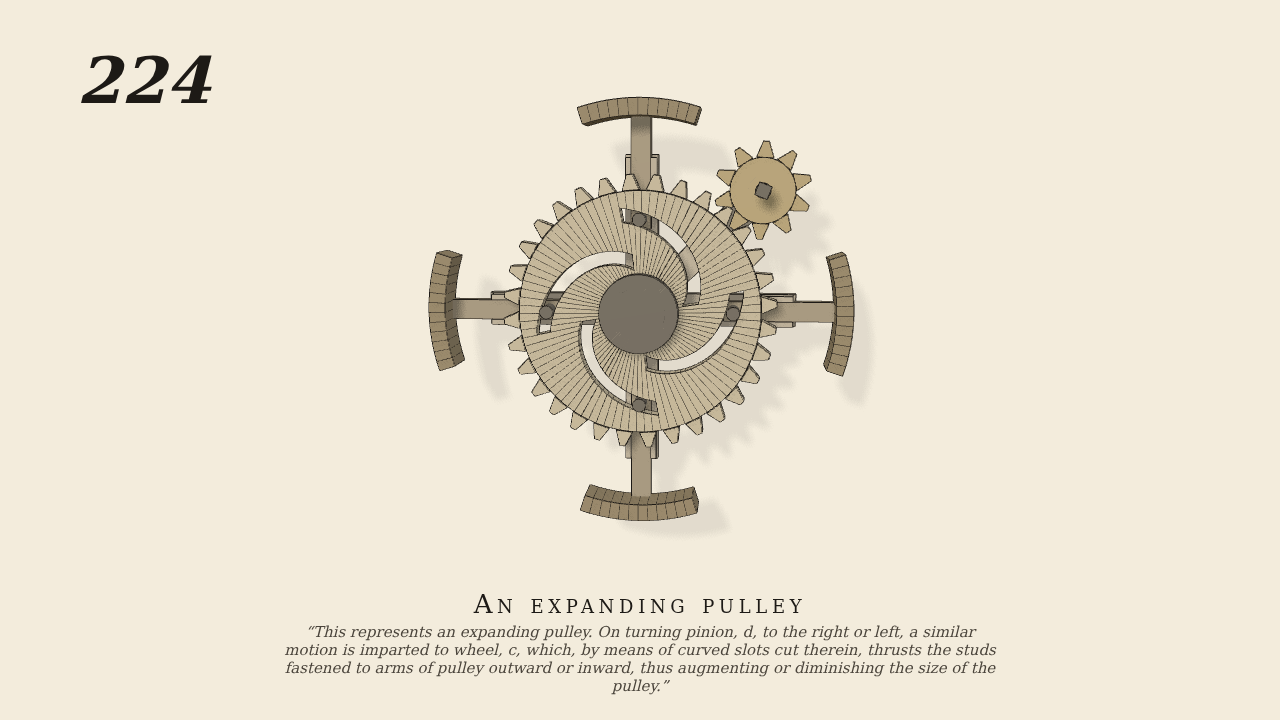
This represents an expanding pulley
This represents an expanding pulley. On turning pinion, d, to the right or left, a similar motion is imparted to wheel, c, which, by means of curved slots cut therein, thrusts the studs fastened to arms of pulley outward or inward, thus augmenting or diminishing the size of the pulley.
Only the input is driven; every other part of this model moves by physics (MuJoCo), and its ratios are measured. Run it live, change its parameters, or switch the friction off to see the output stop.
- Modelled as
- The pulley's hub, spokes and guides are the frame; the pulley is held still while it is set. Wheel c (32 teeth, module 0.5) turns loosely on the hub. It has four curved slots, spirals r = 4.6 + 1.79 (theta - phi) over 48 degrees either side of each arm, so the studs move 1.79 cm for each radian c turns. Pinion d (10 teeth) turns on an axle in the frame and gears with c. Each of the four arms slides in its guides and carries a stud in one of c's slots and a segment of the pulley's rim. A hand rocks d 2 rad to the right and left; it is the only driven joint (gravity on).
- Measured
- c turns -0.3117 rad per radian of d (10/32 the other way). The right arm moves 0.57 cm per radian of d (kinematic 0.56), and the other three follow it at slopes 0.98 to 1.00, so the pulley grows and shrinks by about 2.2 cm in diameter. Max penetration 0.06 mm.
- Notes
- The plate gives no sizes, number of arms or form of slot. Archimedean spirals make the arms' travel proportional to the turn of c. Wheel c has a little viscous and dry friction on the hub (damping 0.05, frictionloss 0.005) to keep it from rattling in the backlash; the pinion is 0.4 kg. The wheel's slotted face is built from 4-degree cells, which show as fine radial lines.
Film (MP4) · Still (PNG) · Spec (YAML) · Model (MJCF)