“Ferguson’s mechanical paradox,” designed to show a curious…
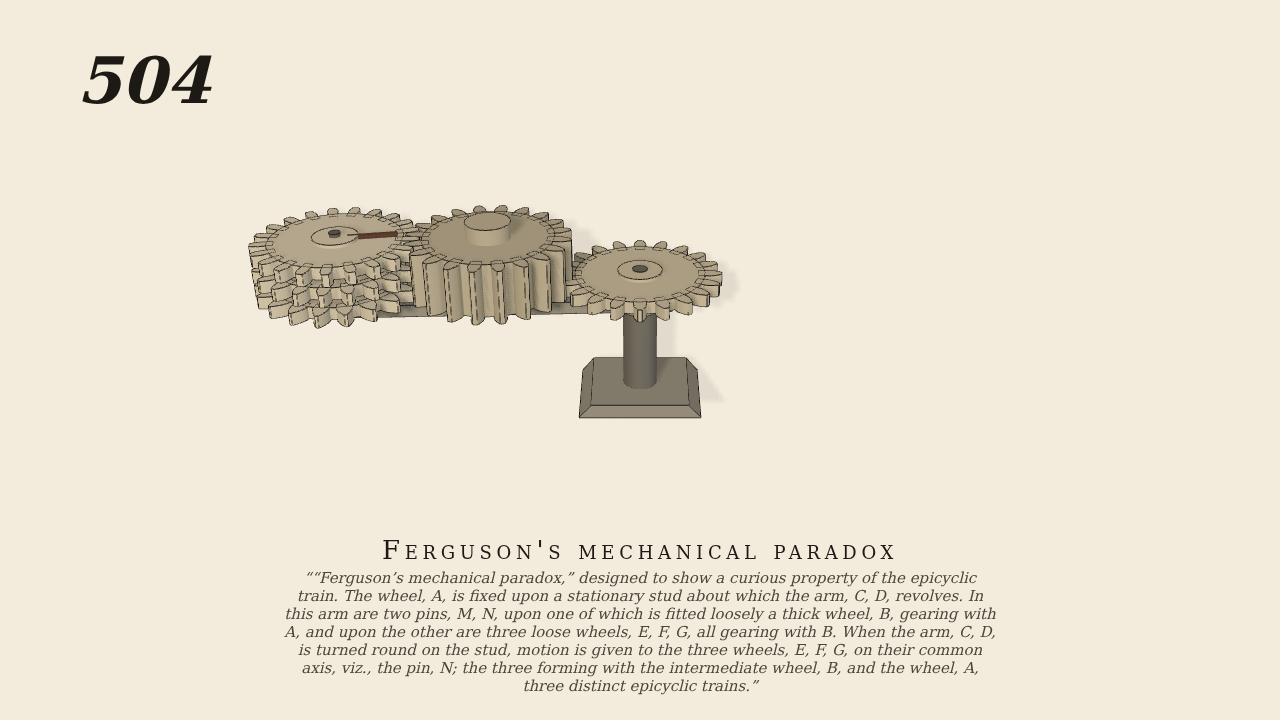
“Ferguson’s mechanical paradox,” designed to show a curious property of the epicyclic train. The wheel, A, is fixed upon a stationary stud about which the arm, C, D, revolves. In this arm are two pins, M, N, upon one of which is fitted loosely a thick wheel, B, gearing with A, and upon the other are three loose wheels, E, F, G, all gearing with B. When the arm, C, D, is turned round on the stud, motion is given to the three wheels, E, F, G, on their common axis, viz., the pin, N; the three forming with the intermediate wheel, B, and the wheel, A, three distinct epicyclic trains. Suppose A to have twenty teeth, F twenty, E twenty-one, and G nineteen; as the arm, E, C, D, is turned round, F will appear not to turn on its axis, as any point in its circumference will always point in one direction, while E will appear to turn slowly in one and G in the other direction, which—an apparent paradox—gave rise to the name of the apparatus.
Only the input is driven; every other part of this model moves by physics (MuJoCo), and its ratios are measured. Run it live, change its parameters, or switch the friction off to see the output stop.
- Modelled as
- Seen from above and to the front, the stud and the wheels upright. A (20 teeth) is fixed on the stationary stud; the arm C, D turns on the stud at a steady 12 rpm - the only input - and carries the thick wheel B (20) loose on the pin M, gearing with A, and on the pin N three thin wheels loose on it and on each other: E (21), F (20) and G (19), all of one pitch diameter and all gearing with B. E and G have their modules and pressure angles set so all three mesh B conjugately at the one centre distance. A dark bar on each of E, F and G shows its turning.
- Measured
- As the arm goes round, B turns once on its pin per turn of the arm, F keeps its bar pointing one way (it does not turn in space), E turns slowly the same way as the arm (1/21 turn per turn) and G slowly the other way (1/19 turn), as the train gives.
- Notes
- Brown shows the wheels one above another on an upright stand; here the stand is plain and the wheels are thin so all three show. The tooth forms of E and G are modified so 21, 20 and 19 teeth can share one pitch circle, as Ferguson's did.
Film (MP4) · Still (PNG) · Spec (YAML) · Model (MJCF)