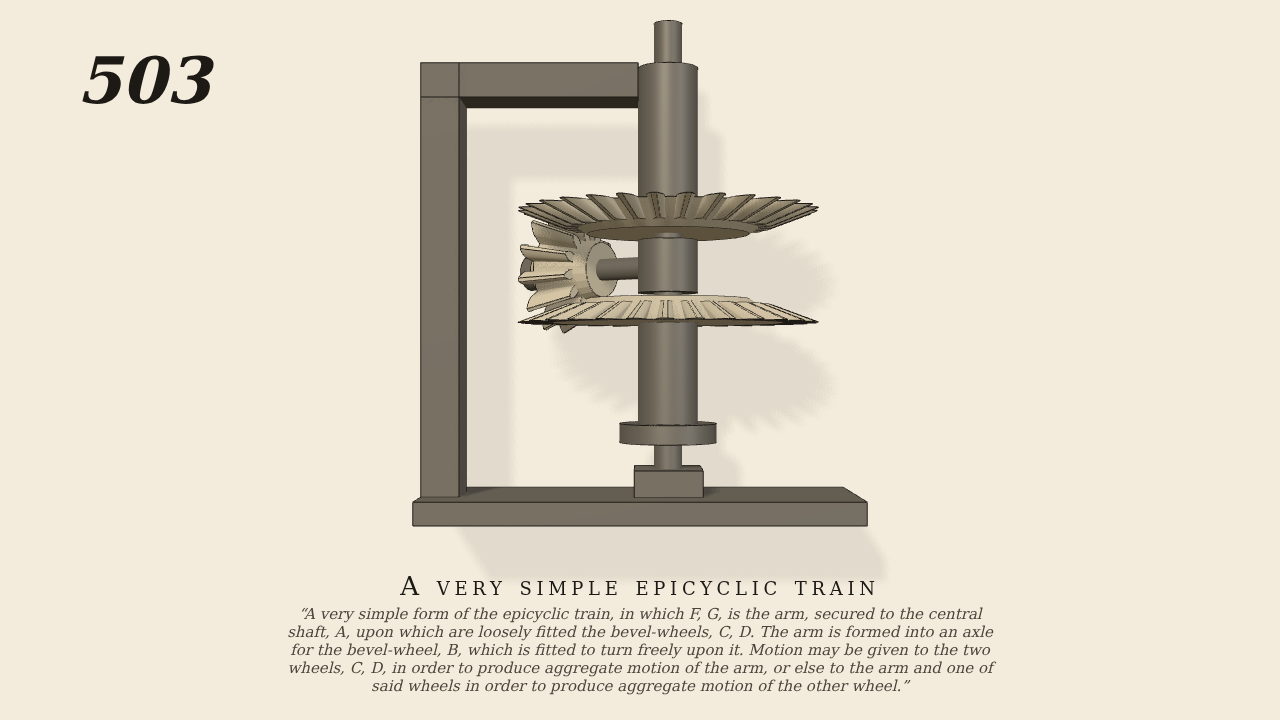
A very simple form of the epicyclic train, in which F, G, is the…
A very simple form of the epicyclic train, in which F, G, is the arm, secured to the central shaft, A, upon which are loosely fitted the bevel-wheels, C, D. The arm is formed into an axle for the bevel-wheel, B, which is fitted to turn freely upon it. Motion may be given to the two wheels, C, D, in order to produce aggregate motion of the arm, or else to the arm and one of said wheels in order to produce aggregate motion of the other wheel.
Only the input is driven; every other part of this model moves by physics (MuJoCo), and its ratios are measured. Run it live, change its parameters, or switch the friction off to see the output stop.
- Modelled as
- Seen from the side, as Brown, the shaft A upright. Straight bevels, module 0.5, apexes at one point on A: the large wheels D above and C below (30 teeth, 7.5 cm pitch radius) and the small B (12 teeth) between them. D is held fast by its hub in a bracket; C is loose on A and turned by its hub at a steady 20 rpm - the only input; B turns freely on the arm G, which stands out from the boss F fast on A, and A takes a light load. The bevels mesh by their real teeth.
- Measured
- C turns B, and B rolls round the fixed D, carrying the arm and the shaft A round at 0.50 of C's speed, the same way, as the train gives (the aggregate motion of the arm with D held).
- Notes
- Brown shows no frame; a plain standard and bracket hold D and the shaft's footstep. B is drawn a little smaller than Brown's. The other use (arm and one wheel driven) is not built.
Film (MP4) · Still (PNG) · Spec (YAML) · Model (MJCF)